
The timezone-switch trap in geo experiments
Geo experiments assume geography is stable. A user is “in” a region, gets the region’s treatment, and outcomes are attributed correctly. Automatic location reporting breaks that assumption in a quiet way: devices and apps can switch timezones (and sometimes inferred region) without a meaningful physical move. The result is phantom lift—apparent incremental impact that is actually caused by measurement and assignment drift.
This shows up most often when you run region-level holdouts, time-based rollouts, or city/state split tests across advertising and analytics stacks that disagree on where and when an event happened.
How automatic location reporting creates phantom lift
1) Event time shifts without a real behavioral change
Many systems store event time in local time by default, then convert later. If a device auto-switches from one timezone to another (travel, VPN, carrier updates, OS changes, daylight saving transitions, or “set timezone automatically” correcting a previously wrong setting), the same user behavior can land in a different reporting day.
In a geo experiment, that can make a treatment region look like it improved simply because conversions moved across a midnight boundary. If your experiment readout is day-bucketed and your exposure is also day-bucketed, misaligned day boundaries are enough to manufacture lift.
2) Exposure and conversion get logged under different “geos”
Platforms don’t agree on what “location” means:
- Ad platforms may use “presence” (estimated location), “home” location, or targeting location, depending on settings and product.
- Analytics tools often infer location from IP, device locale, or account settings.
- CRM systems may store billing/shipping addresses or sales territory, which can lag reality.
If automatic timezone switching triggers a different location inference, exposure can be attributed to one region while conversion is attributed to another. In a holdout design, that cross-region leakage inflates treatment performance and deflates control, even when the campaign did nothing.
3) Reassignment mid-experiment breaks the “stable unit” assumption
Geo experiments rely on stable assignment: a region is treated or held out, and it stays that way. But automatic reporting effectively reassigns units at the user-event level. A single user can contribute events to multiple regions across a week without any meaningful change in address, store access, or market conditions. That violates the experiment model and increases variance while also opening the door to biased lift.
Where the trap is most likely to appear
- Border markets where commuters cross timezones or state lines (or connect to different cell towers).
- Remote-heavy audiences with VPNs, travel, or frequent network switching.
- Mobile-first funnels where device settings drive timestamps and location inference.
- Experiments measured across multiple tools (ad platform + web analytics + CRM) with different time and geo logic.
- Any design with short read windows (daily lift, weekend-only tests, limited-time promos).
Signals you’re seeing phantom lift
Conversion spikes near midnight that don’t match traffic
If conversions cluster around local midnight (or jump when you switch the reporting timezone), that’s a strong hint you’re observing a time-bucketing artifact, not campaign impact.
Lift changes when you change the reporting timezone
Run the same report in UTC and in “account local time.” If the experiment’s estimated lift moves materially, you likely have timezone-driven allocation drift.
Geo-level results look too clean or too noisy
Overly smooth improvements in a few regions can be a sign of systematic misassignment (one pipeline consistently shifting events). On the other hand, an unexplained jump in variance can indicate frequent reclassification of events between regions.
Design choices that reduce timezone-switch bias
Use UTC as the canonical event time
Store and transform all events in UTC, then derive “local day” only for presentation. For experiments, compute exposure windows and conversion windows in the same canonical time standard. If stakeholders need local reporting, render local views off a UTC source—not the other way around.
Define geo from a stable dimension, not whatever the device says today
For region assignment, prefer a stable definition such as:
- Home region (derived from a longer lookback)
- Account-level region (with explicit user selection when possible)
- First-touch region within the experiment window (locked after assignment)
Then treat any subsequent region changes as potential leakage rather than silently reassigning.
Lock assignment at the unit you can actually keep stable
If you can’t keep user-level geo stable, consider assigning at a higher level (DMA, state, country) where small location inference errors don’t flip the unit. This reduces contamination at the cost of fewer experimental units. The right trade-off depends on budget scale and how sensitive your lift model is to leakage.
Choose measurement windows that don’t amplify day-boundary artifacts
Daily reporting is convenient but fragile. For small effects, aggregate to weekly windows, or use rolling windows that reduce the impact of events shifting across midnight. If you must report daily, align all pipelines to the same timezone and daylight-saving rules.
Instrumentation checks before you trust geo lift
Audit timezone fields end-to-end
Document where timezone is captured, how it’s stored, and when it’s converted. Common failure modes include double-conversion (local → UTC → local again), mixed storage (some sources in UTC, some in local), and default-account timezone overriding event timezone.
Track a “geo confidence” and “time confidence” flag
Not every event has equally reliable location/time attribution. Add lightweight flags such as “geo from GPS,” “geo from IP,” “geo from profile,” and “timestamp from server” vs “timestamp from client.” You don’t need perfection—just enough to segment analyses and see whether lift is concentrated in low-confidence events.
Deduplicate definitions across tools
Many phantom-lift incidents are really definition drift: one tool counts conversions on “event time,” another on “processing time”; one uses “presence,” another uses “home.” A simple internal playbook for turning messy inputs into a single prioritized backlog helps teams resolve these inconsistencies systematically rather than ad hoc. See the idea behind an issue intake contract for a single prioritized backlog.
Why data normalization matters more than the experiment model
You can run a statistically sound geo experiment and still get the wrong answer if the underlying data isn’t time- and geo-consistent across channels. This is where marketing data infrastructure becomes a practical control layer. A platform like Funnel.io helps by continuously collecting performance data, standardizing dimensions, and aligning metric definitions so your experiment readout uses one source of truth rather than a patchwork of incompatible timestamps and location logic.
The goal isn’t to “make the lift bigger.” It’s to make lift interpretable. When time and geo are normalized, you can distinguish real incremental impact from artifacts created by automatic timezone switching and shifting location inference.
What to do when you suspect timezone-driven phantom lift
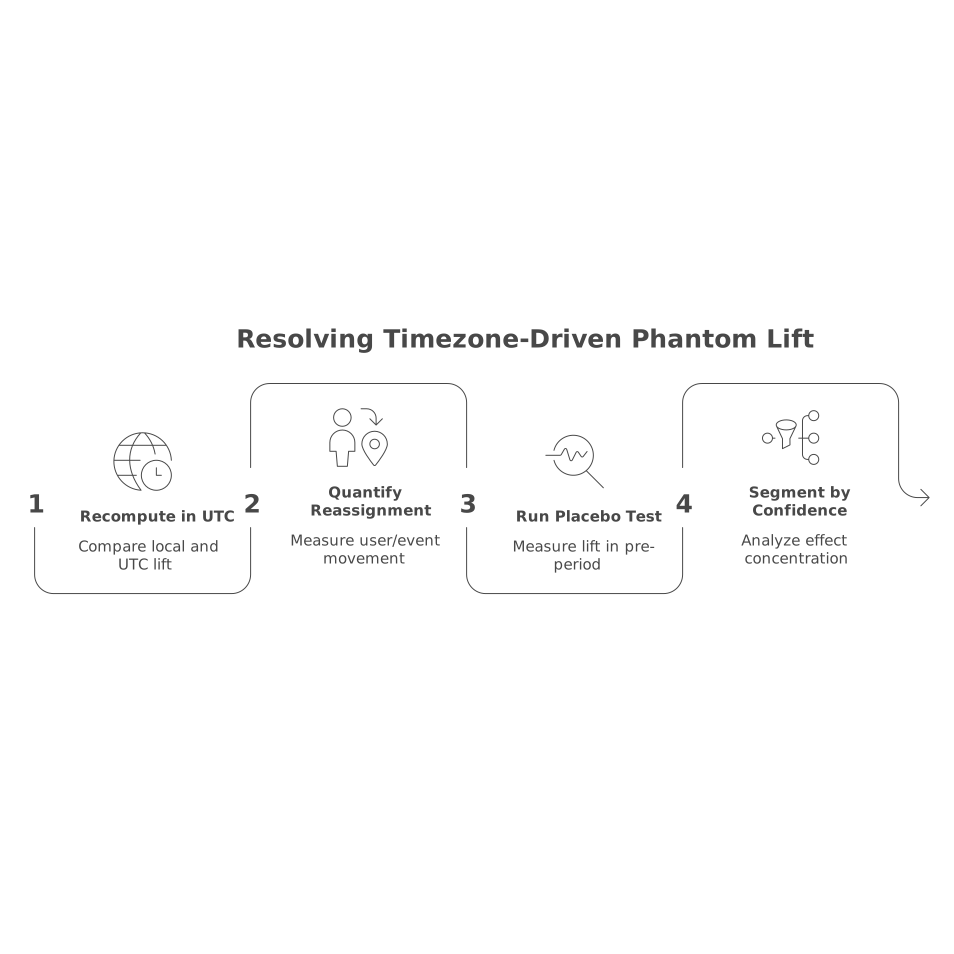
- Recompute lift in UTC and compare to local-time reporting.
- Quantify reassignment: what share of users/events change region or timezone within the experiment window?
- Run a placebo test: choose a pre-period with no intervention and measure “lift.” Any significant effect is a red flag.
- Segment by confidence flags (server-time vs client-time, GPS vs IP) to see where the effect concentrates.
- Lock geo assignment for the next run and treat movers as leakage, not as normal behavior.
Vertical Video