Why the SAT’s last 30 minutes feel harder than the first
The SAT rarely breaks students because the questions suddenly become impossible. It breaks them because attention drops, timing slips, and small errors stack up late in the test. By the final half hour, your brain is doing three jobs at once: solving, self-monitoring, and fighting fatigue. If your practice never reproduces that end-of-test state, you’re training skill but not stamina.
The “stamina curve” problem is simple: most students practice in short bursts when they feel fresh, then expect the same accuracy deep into a full-length exam. The fix is not grinding more full tests until you hate studying. It’s shaping endurance the same way athletes do: targeted stress, controlled volume, and planned recovery.
What actually causes late-test mistakes
Late SAT misses usually come from predictable failure modes:
- Attention drift: rereading the same sentence, missing a key word like “except,” “least,” or “primarily.”
- Time compression: you start rushing, then choose faster-but-riskier methods.
- Working-memory overload: you can still do the problem, but you lose track of steps.
- Decision fatigue: you stop eliminating choices carefully and “go with your gut.”
- Recovery lag: one hard question throws you off for the next two.
Training for the last 30 minutes means training those failure modes, not just reviewing content.
Build a stamina curve on purpose, not by accident
Think of endurance as a curve you can move. Your goal is to keep accuracy stable as minutes pass. The best approach is a three-part routine: end-loaded sets, fatigue-proof error review, and a weekly full-length or near-full-length exposure.
1) End-loaded practice sets (the simplest stamina hack)
Most students start practice when they’re fresh. Flip it. Do a normal warm-up set (10–15 minutes), take a short break, then do your hardest set last when you’re slightly tired.
Structure it like this 3–4 times per week:
- Warm-up: 8–10 medium questions untimed or lightly timed.
- Short reset: 2 minutes. Stand up. Water.
- End-loaded block: 20–25 minutes timed, focused on your weakest skills.
- Two-minute review: mark what felt slippery (not just what you missed).
This teaches your brain that “tired” is not the signal to rush. It’s the signal to simplify and stay precise.
2) Train the final 30 minutes as its own skill
Once per week, do a “last-30” simulation. Don’t take a full practice test if that pushes you toward burnout. Instead, take the final 30 minutes of a realistic section and treat it like the real endgame: strict timing, no phone, minimal breaks, and full bubbling behavior if you normally use a paper format.
Afterward, score it and label each miss by cause:
- Concept gap: you didn’t know how to do it.
- Process error: you knew how, but made a step mistake.
- Attention error: misread, skipped a word, copied wrong.
- Pacing error: ran out of time or guessed early.
That labeling matters because stamina training is mostly about reducing attention and pacing errors under fatigue.
3) Use a “floor method” for late-test reliability
Under fatigue, your ceiling performance matters less than your floor. Build a default method you can trust when you’re tired:
- Reading/Writing: commit to one pass of elimination before selecting any answer.
- Math: write one line per step even when you “see it.”
- Any section: if stuck after 30–45 seconds, mark it, guess strategically, and move. Come back only if time allows.
The floor method prevents the classic late-test spiral where one hard question burns three minutes and costs two easy ones.
Don’t “take more tests” if your review is weak
Stamina gains come from the combination of stress and adaptation. If you keep stressing without adapting, you just accumulate frustration.
Your review needs to be specific enough that the same mistake becomes harder to repeat. If you notice you miss the same type of question again and again, build a ladder: fix the smallest sub-skill first, then climb to harder variations. This is the difference between “I reviewed” and “I improved.” If you want a structured way to do that, the skill-first approach in the Skill-Ladder Method for SAT review maps well to stamina work because it reduces cognitive load late in the test.
A weekly plan that improves stamina without burnout
Use a simple weekly rhythm. Adjust volume based on your test date and school workload.
- 2 days: end-loaded practice sets (45–60 minutes total including review).
- 1 day: “last-30” simulation (30 minutes) + deep review (30–45 minutes).
- 1 day: targeted skill work (30–45 minutes) on the two biggest error categories.
- 1 rest day: zero SAT work or light vocabulary/reading only.
If you’re within 3–4 weeks of test day, add one full-length practice test every 7–10 days, not every weekend by default. The point is quality and recovery, not suffering.
Nutrition, breaks, and pacing that actually matter
Stamina is partly logistics. Small choices show up big in the last half hour.
- Breakfast consistency: practice with the same kind of breakfast you’ll eat on test day.
- Caffeine strategy: don’t experiment on test day. If you use caffeine, practice with it.
- Micro-breaks: 3–5 seconds to reset posture and breathe can prevent a full mental slump.
- Time checks: plan 2–3 specific time checkpoints per section instead of constant clock-watching.
How getsharp fits into stamina training
Stamina work improves fastest when practice stays targeted. If you keep drilling random questions, you waste energy early and arrive at the end already depleted. An adaptive system can keep the difficulty and skill focus aligned with what you actually need that week.
getsharp is built for that style of training: it personalizes practice around weak skills, provides step-by-step explanations when you miss, and updates a study plan as you improve. That matters for the final 30 minutes because the more automatic your core skills become, the less mental bandwidth you spend on basics when you’re tired. If you need a human check-in without scheduling another session, the option to message human tutors asynchronously can also keep your review efficient.
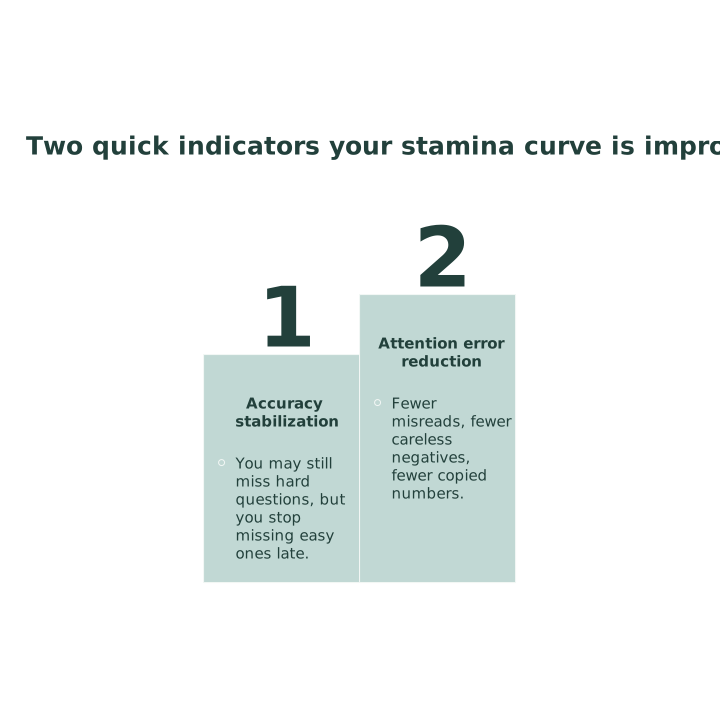
Two quick indicators your stamina curve is improving
- Your last-30 accuracy stops dropping: you may still miss hard questions, but you stop missing easy ones late.
- Your “attention errors” shrink: fewer misreads, fewer careless negatives, fewer copied numbers.
When those indicators move, you’re not just studying more. You’re training the exact version of you who has to finish the SAT strong.
Vertical Video