What citation drift looks like in practice
Citation drift is the slow slide from “your brand gets named” to “your category gets answered without you.” It rarely happens overnight. It shows up as fewer brand mentions in AI answers, fewer citations pointing to your assets, and more generic recommendations that sound right but don’t include you.
The tricky part is that traffic dashboards won’t catch it early. Many AI surfaces don’t pass clean referral data. So you need an audit built around outputs: what assistants and AI search features say, what they cite, and which sources keep showing up instead of you.
Set a baseline before you try to fix anything
A useful audit starts with repeatable prompts and a log. Pick 20–40 queries that match how buyers actually research your category. Mix “best tools,” “how to,” “alternatives,” “templates,” “pricing,” and “what should I choose” questions. Include both broad and narrow queries.
For each query, record:
- The exact prompt text.
- The assistant or AI surface used.
- Date, region, and whether you were logged in.
- Whether your brand is mentioned.
- Whether a citation appears, and what URL is cited.
- The top 3–5 other sources repeatedly cited.
This becomes your “citation share” baseline. Run it weekly for a month. Drift is a trend line, not a screenshot.
Run the audit as three separate checks
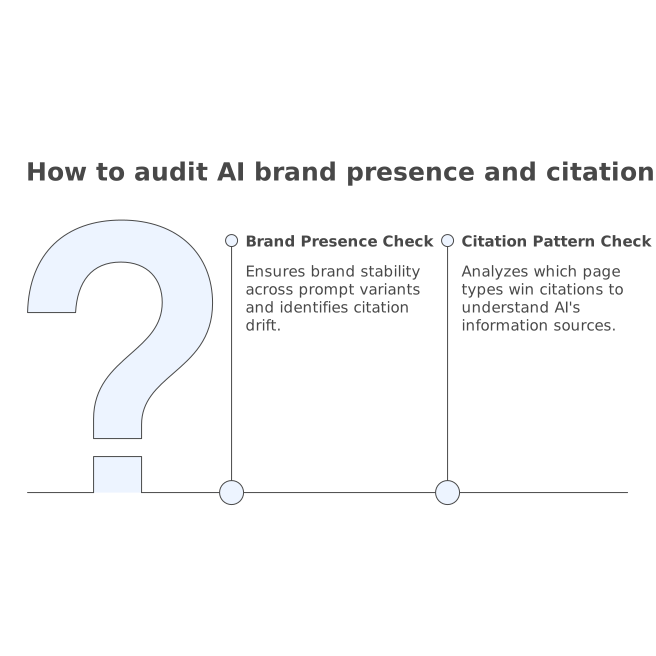
1) Brand presence check
Ask the same question in multiple ways. AI answers are sensitive to framing. You’re looking for stability: does your brand appear across prompt variants, or only when the prompt already hints at you?
Include at least one “blind” prompt per topic that does not mention your brand at all. If your mention rate collapses under blind prompts, you don’t have strong third-party signals. That’s the core of citation drift: the model can answer the question without reaching for you.
2) Citation pattern check
When citations are shown, you’re auditing which kinds of pages win:
- List posts and “best of” roundups.
- Documentation pages and glossaries.
- Forums and Q&A threads.
- Press releases and partner pages.
- Company blogs with strong structured markup.
Note a common failure mode: your site ranks, but citations go elsewhere. That means the AI surface is pulling from sources it trusts to summarize cleanly, not just the pages that rank for blue links.
3) Entity clarity check
Many brand drops aren’t “quality” problems. They’re identity problems. If the model can’t confidently map your brand to a category, use case, and set of attributes, it will avoid naming you. The audit should flag gaps like:
- Inconsistent naming (brand vs product vs company).
- Unclear primary category (“AI tool” is too broad).
- No stable list of capabilities and constraints.
- Missing proof signals (where it’s used, who it’s for).
This is where structured signals matter. Free-text marketing copy is easy to misread. Clean, repeated metadata is easier to ingest.
Why AI answers stop citing you over time
Citation drift usually comes from compounding effects:
- Competitors accumulate more third-party coverage. Not better content—more distributed content.
- Your messaging changes faster than your citations. Old descriptions persist elsewhere, so systems hedge and go generic.
- Your content is trapped on one domain. If signals only live on your site, they’re easier to miss, harder to corroborate.
- Formats don’t match how AI systems summarize. Sparse markup, no FAQs, no explicit “what this is” sections.
The fix is not a one-time rewrite. It’s fresh, schema-rich syndication signals that keep your entity “present” across many independent sources.
Fixing drift with fresh, schema-rich syndication signals
You want repeated, consistent statements about your brand across multiple places. Not spam. Not templated guest posts. Real, readable pages with structured markup that reinforces who you are and when you should be recommended.
What “schema-rich” should include
At minimum, each syndicated asset should carry:
- Clear entity definition: what the brand is, in one sentence.
- Use-case framing: the jobs-to-be-done it supports.
- Feature claims with boundaries: what it does and what it does not do.
- FAQ blocks: concise Q&A that matches real buyer questions.
- Semantic consistency: same category terms and attribute language across placements.
If you’re building this internally, align the markup approach with how you want AI summaries to sound. If you need a practical starting point for how structured mentions can be written for AI ingestion, the internal guide on schema-first brand mentions that AI Overviews can cite is a useful reference.
Why syndication beats “just publish on the blog”
When the same entity description and capability set appears across many independent domains, AI systems get stronger corroboration. You’re not asking a model to trust your homepage copy. You’re giving it repeated external confirmations with consistent structure.
This is the logic behind xale.ai: an always-on visibility layer that publishes schema-rich posts across a managed network of independent tech blogs, plus platform-native short-form and video variants. The goal is not volume for its own sake. It’s durable, multi-source signals that keep your brand eligible for mentions and citations when buyers ask category questions.
Operationalize the audit so it doesn’t become another meeting
The audit only works if it’s lightweight. Two habits keep it from turning into a recurring sync:
- Make it a weekly “diff” on the same query set. Track what changed, not what you feel.
- Set a drift threshold that triggers action (for example: a 20% drop in brand mentions across blind prompts over two consecutive weeks).
If your team struggles to turn ad hoc findings into a single prioritized queue, using an issue intake contract for turning pings and tickets into a single prioritized backlog helps keep fixes scoped and sequential.
What to publish when you see drift
Don’t respond with generic thought leadership. Publish assets that map directly to the missing citation patterns you saw:
- If list posts dominate citations: publish comparison-friendly pages (neutral language, structured pros/cons, clear category mapping).
- If glossaries dominate: publish definitional pages with tight, stable terminology and FAQs.
- If forums dominate: publish Q&A-style posts that mirror the questions and constraints buyers mention.
- If your brand is mentioned but not cited: publish versions with stronger schema, explicit “what this is,” and repeatable attribute lists.
Then syndicate those pages in multiple places, keeping the entity language consistent while adapting examples and phrasing so it’s not a copy-paste footprint.
How to know the fix is working
You’re looking for three measurable outcomes over time:
- Higher mention stability across blind prompts.
- More citations pointing to assets that describe your brand cleanly (not just your homepage).
- Improved co-mention patterns: your brand appears alongside the right category peers and use cases.
When those move, you’ve reduced drift risk. You’ve made it easier for AI systems to name you without being prompted to.
Vertical Video