The post-consent blind spot you didn’t plan for
Consent pop-ups create a measurement gap. Not because they “hurt UX” in the abstract, but because they split your traffic into two populations: people you can fully track and people you can’t. If your analytics relies on cookies or identifiers, any “reject” click turns into missing sessions, missing sources, and missing conversions. The dashboard still shows numbers, but the funnel is no longer complete.
This is the post-consent blind spot: the portion of user journeys that continues on your site after consent is declined, while your measurement quietly stops. You experience it as a sudden conversion rate drop, a spike in “direct” traffic, or campaigns that look like they stopped working.
Why consent banners distort your conversion rate
Your denominator changes, not just your numerator
Conversion rate is conversions divided by visits (or sessions). After a consent prompt, cookie-based tools often undercount visits from non-consenting users. Meanwhile, some conversions still occur (for example, server-side purchases or form submissions you can see in the backend). The ratio becomes unreliable because numerator and denominator are being captured in different ways.
The result can look like “conversion rate dropped,” when what really happened is “measured traffic dropped faster than measured conversions” or the opposite. Either way, the trend is contaminated.
Attribution collapses into “direct” and “unknown”
When storage is blocked, the first thing that breaks is often attribution: UTMs, referrers, and returning visitor logic. Many teams then chase the wrong levers: they cut paid spend because paid looks worse, or they redesign landing pages because bounce rate seems higher. In reality, you’re seeing a reporting artifact.
Consent rates vary by device, region, and intent
Consent acceptance is not random. Mobile users may reject more. Certain geographies may see stricter default settings. Brand-aware users might accept because they trust you, while cold users reject because they’re cautious. That means the tracked subset becomes systematically different from the untracked subset. Comparing “before vs after banner” is rarely apples-to-apples.
A cookie-free measurement playbook for post-consent gaps
The goal isn’t perfect surveillance. It’s consistent, decision-grade measurement that survives consent choices. A cookie-free approach also reduces the operational risk of maintaining parallel tracking stacks and constantly patching broken tags.
1) Decide what must be measured and what can be inferred
Write down the small set of outcomes you actually use to make decisions. For most sites, it’s:
- Overall traffic trend
- Top content and landing pages
- Acquisition channels at a practical granularity
- Core conversions (lead, signup, purchase)
- Funnel drop-offs where you can take action
Everything else is optional. This matters because consent-driven blind spots hurt “nice-to-have” metrics first. If your KPI list is too broad, you’ll spend the next quarter arguing about what’s real.
2) Use analytics that doesn’t depend on cookies
If you want the same measurement rules for consenting and non-consenting users, the simplest move is to avoid cookies and persistent identifiers in the first place. Tools built around aggregate, privacy-first measurement can keep reporting stable after the banner appears.
Plausible Analytics is a practical reference here because it’s designed to work without cookies and without personal data, while still giving a clear dashboard for traffic, sources, pages, and goals. If you want a starting point that reduces post-consent discontinuities, see plausible.io.
3) Shift conversions to first-party events you control
Cookie-free measurement is strongest when the conversion is defined by a first-party action, not by third-party tags. Examples:
- Thank-you page views (lead submitted, trial created)
- Custom events on key clicks (pricing CTA, outbound demo scheduler)
- Revenue attribution at checkout confirmation
- File download and form completion events
The key is consistency: define the event once, keep the naming stable, and avoid duplicating it across multiple tag managers and pixels.
4) Build “consent resilience” into your funnel reporting
Even in a cookie-free setup, some funnel steps can be fragile (cross-domain checkouts, embedded schedulers, payment providers). Treat these as known weak points and design around them:
- Prefer same-domain flows where possible.
- If a third-party step is unavoidable, measure the last reliable on-site step plus the confirmed backend outcome.
- Keep funnels short and action-based (e.g., “Visited pricing” → “Started signup” → “Created account”).
When a step is not measurable for all users, don’t pretend it is. Make the funnel explicit about where measurement ends and backend truth begins.
5) Reconcile analytics with backend truth on a schedule
Your CRM, database, billing system, and support inbox are where consent can’t erase outcomes. Create a lightweight weekly reconciliation:
- Compare analytics conversions to backend counts for the same period.
- Track the gap as a metric (not as an embarrassment).
- Investigate only when the gap changes sharply.
This turns “we don’t trust analytics anymore” into “we know the error bars.” It also prevents reactive decisions driven by a single dashboard number.
6) Lock down metric definitions to prevent drift
Consent prompts often trigger a second wave of tracking changes: new tags, different consent modes, patched UTMs, alternate conversion definitions. That’s how KPI definitions drift without anyone noticing. If you’ve ever had “signups” mean three different things across tools, you’ve felt this.
Document your key metrics and their event definitions, and keep them consistent across platforms. If you need a structured way to do this, the workflow in metric mapping drift and how to keep KPI definitions consistent across platforms is directly applicable.
Diagnosing a conversion-rate “drop” after a banner launch
Check for step changes and segmentation artifacts
Look for a clean step change on the date the consent banner went live. Then segment by device and region. If the “drop” concentrates in segments with lower consent rates (often mobile or specific jurisdictions), you’re likely seeing tracking loss rather than true performance decline.
Compare three views of reality
- Analytics view: what your measurement tool recorded.
- Backend view: actual leads, signups, purchases.
- Marketing platform view: click and impression trends.
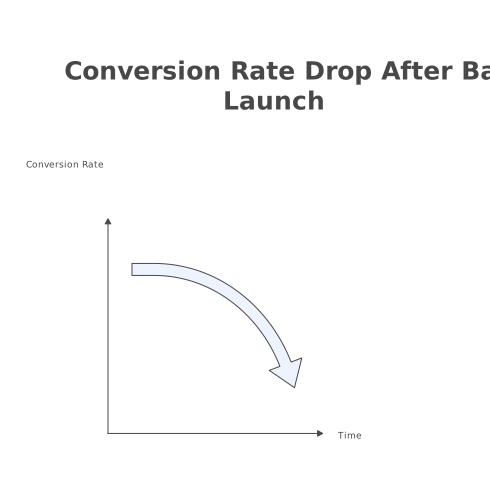
If backend outcomes are stable while analytics sessions fall, your denominator is broken. If sessions are stable but attributed sources shift to “direct,” your attribution is broken. Treat these as separate failure modes with separate fixes.
What “good” looks like after consent pop-ups
You don’t need perfect user-level tracking to run a high-performing site. You need stable trends, reliable conversion counts, and attribution that’s good enough to choose what to do next. Cookie-free measurement helps because it removes the consent-driven split between “tracked” and “untracked” visitors, so your reporting behaves more like an instrument panel and less like a patchwork of exceptions.
Once the blind spot is acknowledged, the playbook is straightforward: measure fewer things, define them clearly, and rely on first-party, aggregate signals that don’t disappear when users exercise choice.
Vertical Video