The AI crawl budget problem and why it increases hallucinations
Search engines have crawl budgets. LLMs have something similar, even if nobody exposes the meter. When an AI system tries to answer a question about your product, it has limited time and limited context. If your site sends conflicting signals, the model will “spend” that budget reconciling ambiguity instead of extracting facts. That’s when you get hallucinations: wrong pricing, wrong founders, outdated features, or the mix-up of two companies with similar names.
Think of “AI crawl budget” as the sum of:
- How many relevant pages the system can fetch or embed from your domain
- How quickly it can decide which version is canonical
- How confidently it can map your pages to stable entities (brand, product, people, locations)
- How much contradictory markup, duplicate URLs, and fuzzy naming it must resolve
You can’t control how every LLM crawls. You can control how expensive it is for an AI to understand you.
Where the budget gets wasted
1) Structured data that is incomplete, inconsistent, or over-decorated
Most sites either don’t have schema at all, or they have “SEO schema” that doesn’t match the page. Both are costly for AI systems. If your JSON-LD says one thing and the visible page says another, the model must choose. If you generate different schema on similar templates, the model must infer what changed and what stayed the same.
Common waste patterns:
- Organization markup on every page with different
name,url, orlogovalues - Product markup without stable identifiers (SKU/MPN), or with changing
offersfields across duplicate pages - FAQ markup that paraphrases what the page never actually states
- Breadcrumb markup that disagrees with internal navigation
For AEO/GEO, the goal is not “more schema.” The goal is consistent schema that reduces interpretation.
2) Canonical and redirect confusion
If the same content is reachable via multiple URLs, an LLM’s retrieval layer can pick the wrong one. That creates outdated answers, mixed variants, and citations that don’t match what users see. Canonicals and redirects are the cheapest way to stop that.
High-frequency issues:
- Both
httpandhttpslive - Both
wwwand non-wwwlive - Trailing slash and non-trailing slash versions indexable
- UTM and parameter URLs self-canonicalizing
- Pagination and faceted navigation generating thousands of near-duplicates
When canonicals are missing or contradictory, you’re forcing the model to do URL deduplication itself. That’s expensive. And it often fails.
3) Entity ambiguity across the site
Entity ambiguity is where hallucinations get personal: founders swapped, company description borrowed from another brand, or product features attributed to the wrong offering. This happens when your site doesn’t clearly and repeatedly anchor:
- Who you are (Organization)
- What you sell (Product/Service)
- Who is involved (Person)
- What terms mean (glossary-level clarity for domain jargon)
Ambiguity also comes from editorial habits: inconsistent naming (“Lunem”, “Lunem AI”, “lunem.ai”), vague pronouns (“we built it”), or pages that assume context that the model may not have when retrieved in isolation.
A practical remediation plan that reduces hallucinations
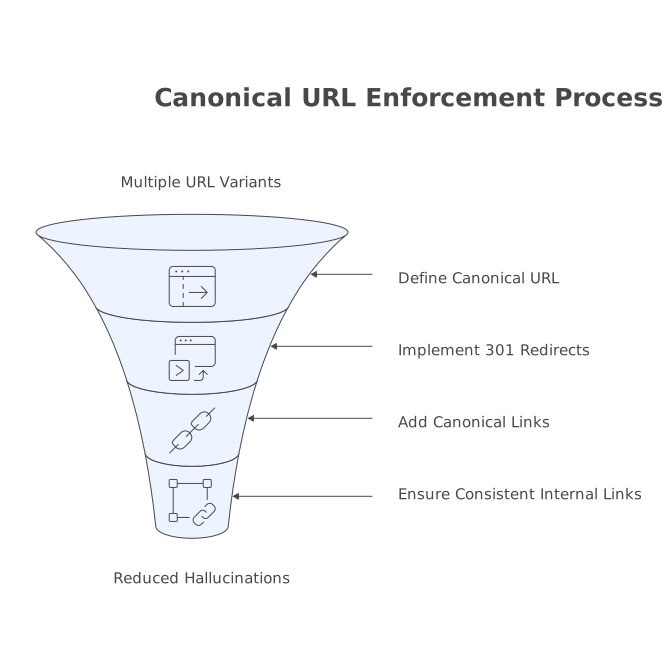
Step 1: Decide your canonical URL policy and enforce it
Pick one host and one protocol (usually https + one of www or non-www). Then enforce it with:
- 301 redirects from all variants to the preferred version
- Self-referential
<link rel="canonical">on every indexable page - Consistent internal links (don’t link to non-canonical variants)
For parameter URLs, set a strict rule: either they are blocked/noindexed, or they canonicalize to a clean URL. Don’t let them “float.”
Step 2: Build a minimal, consistent schema spine
Start with a small set of schema types that you can keep accurate:
Organizationon the homepage (and optionally sitewide if values are identical)WebSiteandWebPagewith stableurlArticle/BlogPostingfor editorial contentProductorServicefor core offerings, with stable identifiers and a consistent name
Two rules prevent most AI confusion:
- Schema must match what the page states in plain text.
- Schema values must be consistent across templates and languages.
If your content team ships frequent updates, treat schema as part of the release, not an afterthought. Otherwise the model learns an older “truth.”
Step 3: Reduce entity ambiguity with explicit naming and page-level context
LLMs often retrieve a single page, not your entire site. Each important page should stand alone. That means adding short, explicit context blocks where it matters:
- At the top of product pages: what the product is, for whom, and what it replaces
- On pricing pages: effective date, plan names, and what “included” means
- On about pages: legal name, brand name, and a one-sentence description repeated consistently
Also normalize your terminology. If you use a concept like “AEO” or “GEO,” define it once in a canonical glossary page and link to it internally. That reduces the model’s need to infer meaning from scattered mentions.
Step 4: Align internal linking with how AI retrieves information
Internal links are not only for SEO. They are retrieval hints. When an AI system reads one page and then follows a small number of links, you want it to land on your highest-trust clarifiers: pricing, product definition, docs, and the most current feature set.
Two patterns help:
- Add “definition links” near first mention of important entities (product name, key feature, acronym).
- Use stable, descriptive anchors that match how people ask questions.
If your team is already instrumenting how users engage with content, you can reuse that logic to prioritize which clarifier pages must be the cleanest. The approach in Estimating Visitor Engagement Without Cookies Using Scroll Depth and First-Party Events pairs well with identifying the pages that need the strongest entity signals.
Step 5: Monitor how LLMs interpret your site, not just how Google indexes it
Classic SEO audits tell you if a page is indexable. They don’t tell you how often an LLM misattributes your features or confuses your brand with another entity. That’s the gap an AEO/GEO workflow needs to close.
lunem is built around that problem: connecting directly to a website, continuously monitoring how content is interpreted and surfaced across AI environments, and reporting where structure and entity clarity break down. Its use of PEEC data is especially useful when you’re trying to separate “the page exists” from “the model actually understood the page and used it correctly.”
Operationally, treat AI visibility issues like product bugs: intake, triage, fix, verify. If you need a lightweight way to standardize that flow, an issue intake contract similar to turning pings and tickets into a single prioritized backlog helps keep schema and canonical fixes from getting stuck in ad hoc requests.
What success looks like after cleanup
- Fewer duplicated or conflicting URLs showing up in AI citations
- More stable answers about your plans, features, and positioning
- Cleaner brand/entity attribution (less “company mix-up” behavior)
- Higher confidence retrieval because pages carry context and consistent structured data
The point is not to chase every model. It’s to lower the cost of understanding your site so that the limited “AI crawl budget” gets spent on your facts, not on resolving your ambiguity.
Vertical Video