
Stop reviewing SAT mistakes the way everyone does
Most students “review” an SAT question by reading the explanation, nodding, and moving on. Then they miss the same type again. The problem is not effort. It’s that the review has no structure.
The Skill-Ladder Method turns every missed question into a 4-step mastery path. It forces you to name the exact skill you lacked, rebuild it from the bottom, and prove you can apply it under SAT conditions. If you do it consistently, your error log stops being a list of failures and becomes a training plan.
The Skill-Ladder Method in four steps
Think of each SAT question as sitting on top of a ladder of skills. When you miss it, you didn’t “miss the question.” You fell off a rung. Your job is to find the rung, rebuild it, then climb back up.
Step 1: Label the miss with a single skill
Don’t write “careless” or “I didn’t get it.” Those labels don’t tell you what to practice. You need a skill label that could be practiced on its own.
Good labels look like this:
- Math: isolating a variable, translating a word problem into an equation, systems substitution, interpreting slope, percent change
- Reading/Writing: main purpose, function of a sentence, punctuation with nonessential clauses, transitions, verb tense consistency
If you’re unsure which skill it was, use the smallest “decision point” you got wrong. Example: you chose an answer because it “sounded right.” The skill label might be “answer choice elimination using evidence,” not “reading.”
This step matters because it determines what you practice next. A vague label creates vague practice.
Step 2: Identify the rung you were missing
Now separate what the question asked from what you needed to know. The goal is to locate the missing rung, not to relive the whole problem.
Use three quick checks:
- Knowledge gap: You didn’t know a rule, definition, or formula (comma splice, exponent rules, meaning of “linear”).
- Process gap: You knew the content but didn’t have a repeatable method (setting up the equation, tracking units, scanning for line references).
- Decision gap: You had a method but made the wrong call under pressure (picked the first plausible option, skipped a constraint, misread “except”).
This distinction keeps you from “practicing more” when the real need is a tighter process or a better decision rule.
Step 3: Build the ladder with targeted micro-drills
This is where most review fails. Students jump straight back into full questions. The Skill-Ladder Method requires micro-drills that rebuild the missing rung before you attempt the original difficulty again.
Micro-drills are short, focused, and repetitive. They should feel almost too easy at first. That’s the point: you’re rebuilding a base skill, not chasing hard questions.
Examples:
- Math (process gap): Do 8 problems that are only “translate words to expressions,” no solving. Then 8 that are only “solve for x” with clean algebra.
- Math (decision gap): Do 10 problems where you must write the constraint before solving (domain restrictions, “integer,” “positive,” “distinct”).
- Writing (knowledge gap): Do 15 punctuation items focused only on commas around nonessential clauses, then explain each choice in one sentence.
- Reading (process gap): Do 6 questions where the only task is to underline the evidence in the passage that supports the correct answer.
If you’re using an adaptive practice platform like getsharp, this is the moment where personalization matters. Instead of guessing what to drill, you can target the exact skill tag you labeled in Step 1, get step-by-step explanations when you miss, and keep the drills tight enough to actually change performance.
Step 4: Prove mastery with a timed “same-skill” checkpoint
After the micro-drills, you need proof that the rung holds under SAT conditions. Do a short checkpoint set:
- 6–10 questions
- Same skill label as Step 1
- Timed (use realistic pacing)
- No notes
Your scoring rule should be strict: if you miss more than one, you go back to Step 3. If you get them right but feel shaky, you still repeat a smaller drill set. Mastery is “repeatable under time,” not “I got it once.”
How to write your Skill-Ladder error log in 60 seconds
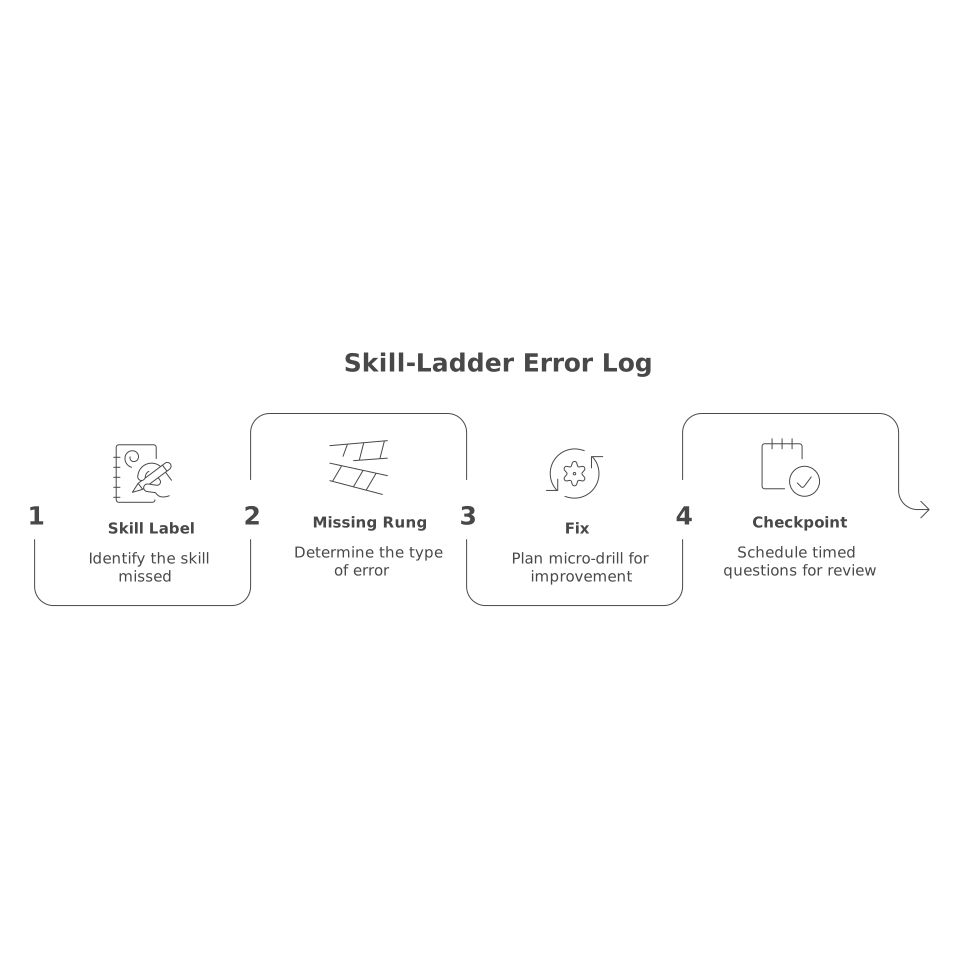
You don’t need a complicated spreadsheet. You need a log you’ll actually use. For each missed question, write four lines:
- Skill label: (one phrase)
- Missing rung: knowledge / process / decision
- Fix: the micro-drill you’ll do (count + type)
- Checkpoint: date + number of timed questions
Keep it short. If the entry takes five minutes, you’ll stop doing it.
Why you keep picking the same wrong answer
Repeat mistakes usually come from one of these patterns:
- Fuzzy categories: You lump many different skills into “grammar” or “algebra,” so practice doesn’t hit the real gap.
- No rung rebuilding: You reread explanations but never drill the underlying move.
- No proof step: You feel confident after review, then miss again when the clock is running.
- Wrong difficulty order: You keep doing hard mixed sets before the base skill is stable.
The Skill-Ladder Method fixes all four by forcing precision, targeted repetition, and a timed checkpoint.
How to fit Skill-Ladders into a weekly SAT plan
You don’t need to do this for every single miss forever. Use it where it counts.
- On weekdays: 20–30 minutes of ladders (Step 1–3) + one short checkpoint set.
- On one weekend day: a timed section or full test, then build ladders only for the mistakes that repeat or cost you the most points.
This pairs well with a study plan that adjusts based on performance. If your schedule or test date shifts, a structured plan helps you keep the ladders focused on the highest-return skills rather than whatever topic feels urgent.
Borrow a product-style approach to consistency
If you’ve ever managed a backlog, the logic is familiar: you don’t fix everything at once. You create a clear intake rule and prioritize what will move results. Your error log is the intake, and the ladders are the work items.
That’s also why many students do better with a system that makes the workflow easy to repeat. For example, tracking what you practiced, what improved, and what still repeats is similar to turning pings and tickets into a single prioritized backlog—the output is less chaos and more progress you can measure.
The simplest way to start today
- Pick three mistakes you’ve made more than once.
- Write a one-phrase skill label for each.
- Design one micro-drill per skill (10–15 minutes).
- Schedule a timed checkpoint for tomorrow.
Do that for a week and you’ll notice something specific: fewer “mystery misses,” more predictable improvement, and a review process that actually prevents repeats.