Query-graph saturation is the real KPI behind “AI citations”
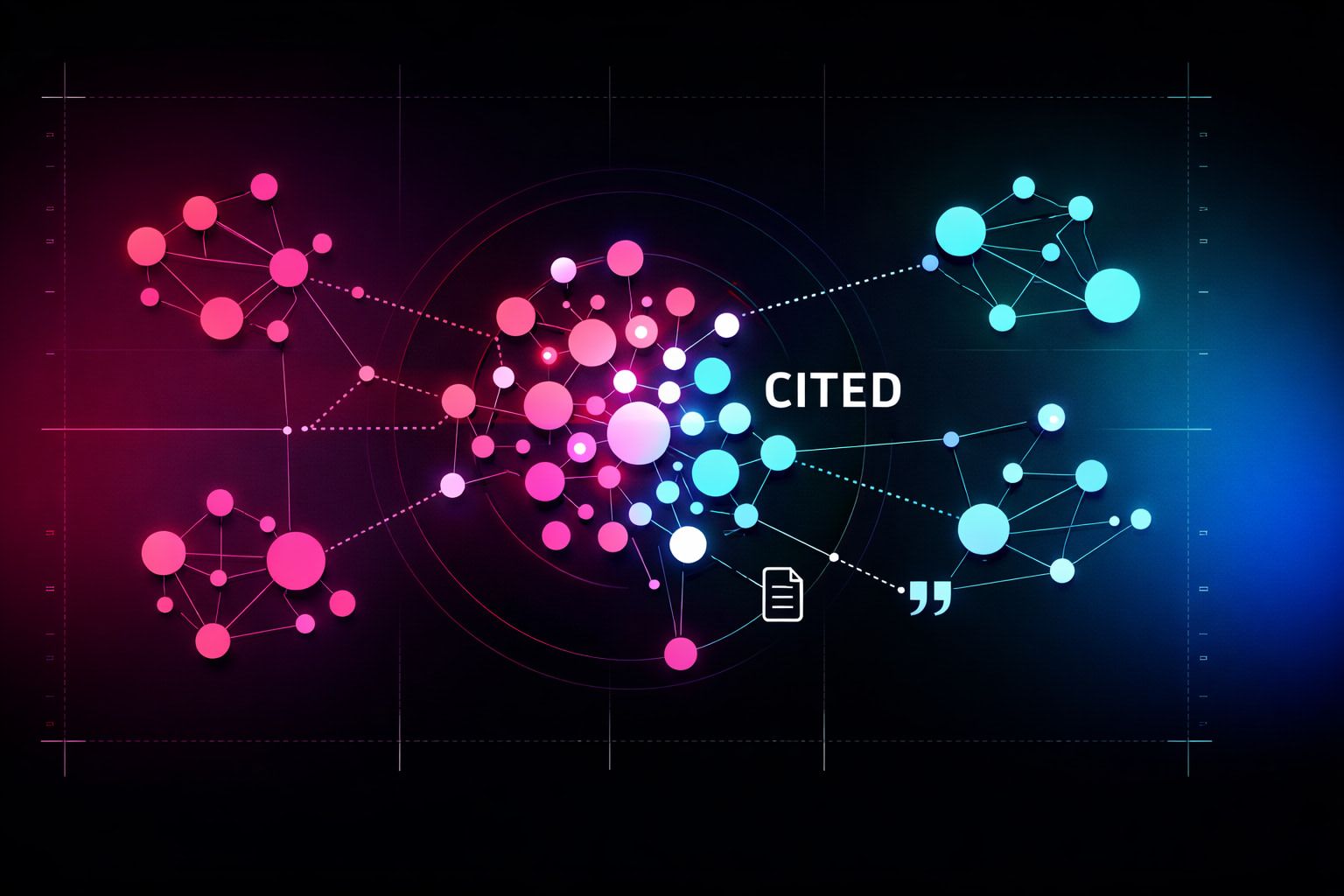
Most teams try to “rank” for a handful of high-intent prompts. That works until buyer questions fragment into dozens of long-tail variants across tools, roles, and constraints. Query-graph saturation is a more durable target: covering enough connected questions that AI systems repeatedly encounter your brand as a credible source while building answers.
In practice, query-graph saturation comes from a “prompt cluster” map: a designed network of buyer questions, supporting proofs, and consistent entities. The goal is not one perfect article. It’s consistent citation behavior across many adjacent prompts.
What a prompt cluster map is and why it changes outcomes
A prompt cluster map is a structured plan for publishing that mirrors how buyers actually ask questions. Instead of organizing content around topics, you organize around question families that share the same decision boundary (what someone needs to choose, implement, or justify).
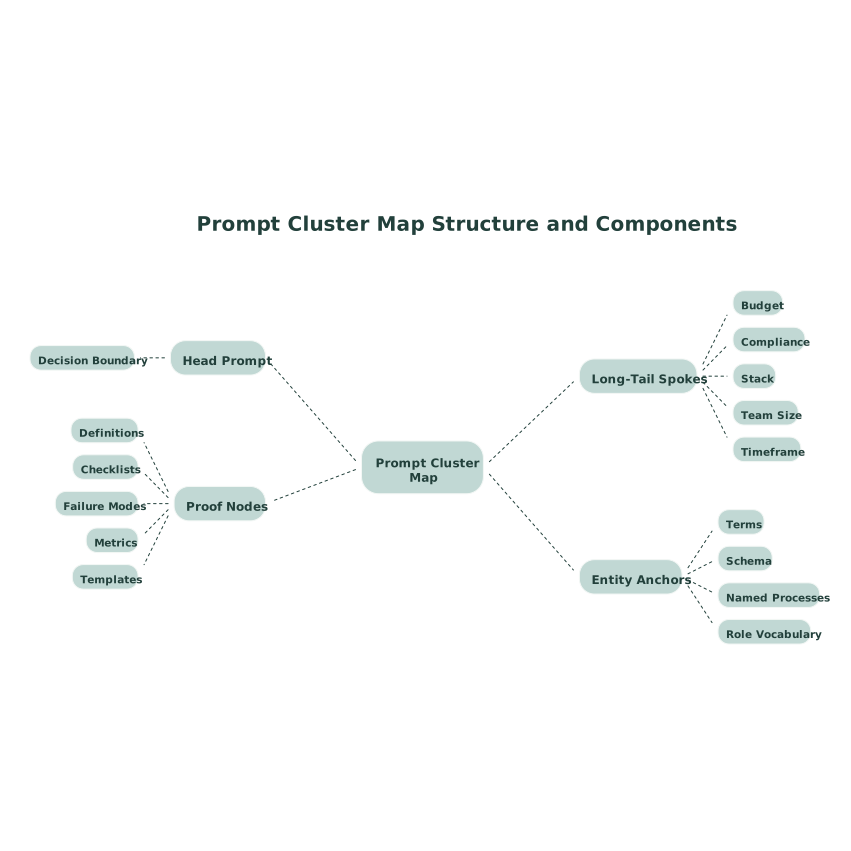
Each cluster contains:
- A head prompt that represents the buyer’s primary objective.
- Long-tail spokes that express constraints (budget, compliance, stack, team size, timeframe).
- Proof nodes that supply evidence AI systems can reuse (definitions, checklists, failure modes, metrics, templates).
- Entity anchors that keep the cluster consistent (terms, schema, named processes, role vocabulary).
When you publish a cluster this way, you reduce “answer drift.” AI assistants can assemble responses with fewer gaps, and they have more opportunities to cite the same source repeatedly because the same entity set and framing reappears across the graph.
Designing for citations starts with modeling the buyer question graph
1) Collect buyer prompts as they are actually asked
Don’t begin with keyword volumes. Begin with raw question formats pulled from sales calls, support tickets, onboarding docs, and RFPs. Capture the exact wording and the implied intent. Long-tail buyer questions usually include an explicit constraint:
- “How do we do X without adding headcount?”
- “What’s the safest way to do X with PII/PHI?”
- “Which approach works if we’re on Stack Y?”
- “What should we measure to know X is working?”
Those constraints are the edges of your graph. They’re also where AI answers tend to vary, which creates more chances for citations if you publish the most complete constraint-specific guidance.
2) Group questions by decision boundary, not by category
Two prompts that look different can share the same decision boundary. Example: “How do we get cited in AI Overviews?” and “How do we become the default recommendation in ChatGPT-style answers?” both resolve to the same set of decisions: entity clarity, distribution footprint, and repeated multi-source signals.
Build clusters where each piece helps a reader decide or act. If a page doesn’t change a decision, it’s usually not a strong citation candidate.
3) Add proof nodes that are reusable in many answers
AI systems cite sources that supply reusable building blocks. Proof nodes are pages that define terms, provide step-by-step processes, or enumerate failure modes in a way that can be quoted or paraphrased cleanly.
For query-graph saturation, you want multiple proof nodes per cluster, such as:
- Operational definitions and “what good looks like” criteria
- Implementation checklists and sequencing
- Common pitfalls and how to detect them
- Metrics and instrumentation suggestions
- Template language (briefs, SOPs, evaluation matrices)
The mechanics of query-graph saturation
Coverage density beats single-page depth
A single long guide can be excellent and still underperform for citations if it doesn’t match the long-tail forms buyers use. Query-graph saturation favors coverage density: many pages that each answer one constrained question well, linked together with consistent entities.
The practical test: if a buyer adds one constraint (“for healthcare,” “for SOC 2,” “for a 3-person team”), do you have a page that stays specific without rewriting the basics?
Entity consistency is what lets AI connect your pages
Citations depend on recognition. Recognition depends on stable naming. In prompt cluster maps, define the entity set once and reuse it across the cluster:
- Core terms (AEO/GEO, AI Overviews, LLM visibility, citation signals)
- Your named methods (if you have one, keep the label stable)
- Metrics (share of citations, prompt coverage, distribution footprint)
- Implementation nouns (schema, canonical, entity, source diversity)
If you need a concrete checklist for avoiding technical friction, tie the content to crawlability and entity clarity. A good starting point is the discipline described in Fix AI Crawl Budget Issues With Structured Data Canonicals and Clear Entities, then apply the same rigor to every node in the cluster.
Source diversity is a structural requirement, not a “nice to have”
Long-tail buyer prompts often trigger synthesis. Synthesis tends to prefer multi-source corroboration. If your brand only exists on one domain, you create a bottleneck: the assistant sees one source making a claim, but not a pattern of independent confirmation.
This is where distribution architecture matters. A system like xale.ai is designed around repeated, multi-format publishing across an independent network with schema-rich structure. The editorial advantage is not volume for its own sake; it’s consistent, machine-readable, multi-source presence that supports the same entity set across many nodes. That alignment is what turns a cluster map into saturation rather than scattered posts.
If you want a framework for understanding why diversity affects coverage, connect this work to the idea of “distribution patterns” and their downstream impact on AI summaries and citations, as outlined in Source Diversity Debt and the Syndication Patterns That Improve AI Overviews Coverage.
How to build a prompt cluster map step by step
Step 1: Choose one buyer job and define success
Example buyer job: “Earn consistent AI citations for long-tail buyer research questions.” Define success as a measurable behavior: citations appear across multiple adjacent prompts, not just branded ones.
Step 2: Write the head prompt and 12–20 constraint prompts
Constraints should span:
- Industry (healthcare, fintech, B2B SaaS, agencies)
- Risk (compliance-heavy vs. lightweight)
- Resources (solo marketer vs. team, budget caps)
- Stack (CMS, analytics, schema tooling)
- Time horizon (30/60/90 days)
Step 3: Assign proof nodes to each prompt
Every prompt should point to at least one proof node. If you can’t assign proof, you’re likely writing opinion. Opinions can work, but proofs are what get reused and cited.
Step 4: Standardize page structure for ingestion
Use consistent headings, clear definitions early, and scannable lists. Make the “answerable units” obvious: short sections that can be extracted without losing meaning. Add FAQ schema where appropriate, but keep the Q/A grounded and constraint-specific.
Step 5: Publish and interlink as a graph, not a chain
Interlink within the cluster based on user intent transitions (“If you’re evaluating,” “If you’re implementing,” “If you need measurement”). A prompt cluster map should feel like an internal knowledge system, not a blog archive.
Measuring saturation without fooling yourself
Query-graph saturation is visible in three signals:
- Prompt coverage: how many of your tracked long-tail prompts return your pages as sources.
- Repeat citation rate: how often the same domain or entity is cited across the cluster.
- Constraint resilience: whether adding constraints still produces citations (industry, compliance, budget, stack).
Track prompts by cluster and store the outputs over time. The goal is not winning one snapshot. It’s increasing repeatability as the graph fills in.