
Why deterministic tool output matters for agent reliability
AI agents fail in boring, expensive ways. Two identical prompts can trigger two slightly different tool calls. Two identical tool calls can return payloads that differ in whitespace, ordering, timestamps, or floating-point formatting. Later, when you try to audit a decision, reproduce a run, or reconcile billing, you discover you can’t prove what happened.
A tamper-evident proxy layer solves this by sitting between the agent and every external tool (HTTP APIs, databases, queues, SaaS actions). It forces consistency through canonicalization, prevents accidental repeats through idempotency keys, and makes responses verifiable through hashing. The goal is not to remove nondeterminism from the world. It’s to make the parts you control repeatable and auditable.
Architecture overview of a proxy layer
The proxy acts as the single egress point for tool usage. The agent never calls tools directly. Instead it sends a structured “tool intent” to the proxy, which:
- Normalizes inputs into a canonical form.
- Generates or validates idempotency keys for side-effecting operations.
- Executes the tool call (or returns a cached result when appropriate).
- Canonicalizes the response payload.
- Hashes and logs a tamper-evident record of the exchange.
This layer can live at the edge or close to your agents. In practice, a globally distributed runtime helps when agents run in multiple regions and still need consistent enforcement. Cloudflare’s developer platform is a natural fit for this kind of “policy at the boundary” pattern, and the same global network that protects applications can also standardize outbound agent traffic. For reference context, see cloudflare.com.
Canonicalization as the foundation for determinism
Canonicalization turns “equivalent” data into identical bytes. Without it, response hashing is fragile and idempotency caches miss due to irrelevant differences.
Canonicalizing tool requests
Start with a strict request envelope that the agent must use. Typical fields:
- tool_name and tool_version
- operation (e.g., “create_invoice”, “fetch_customer”)
- params (structured, typed)
- caller (agent id, workspace id, environment)
- trace (run id, step id, parent id)
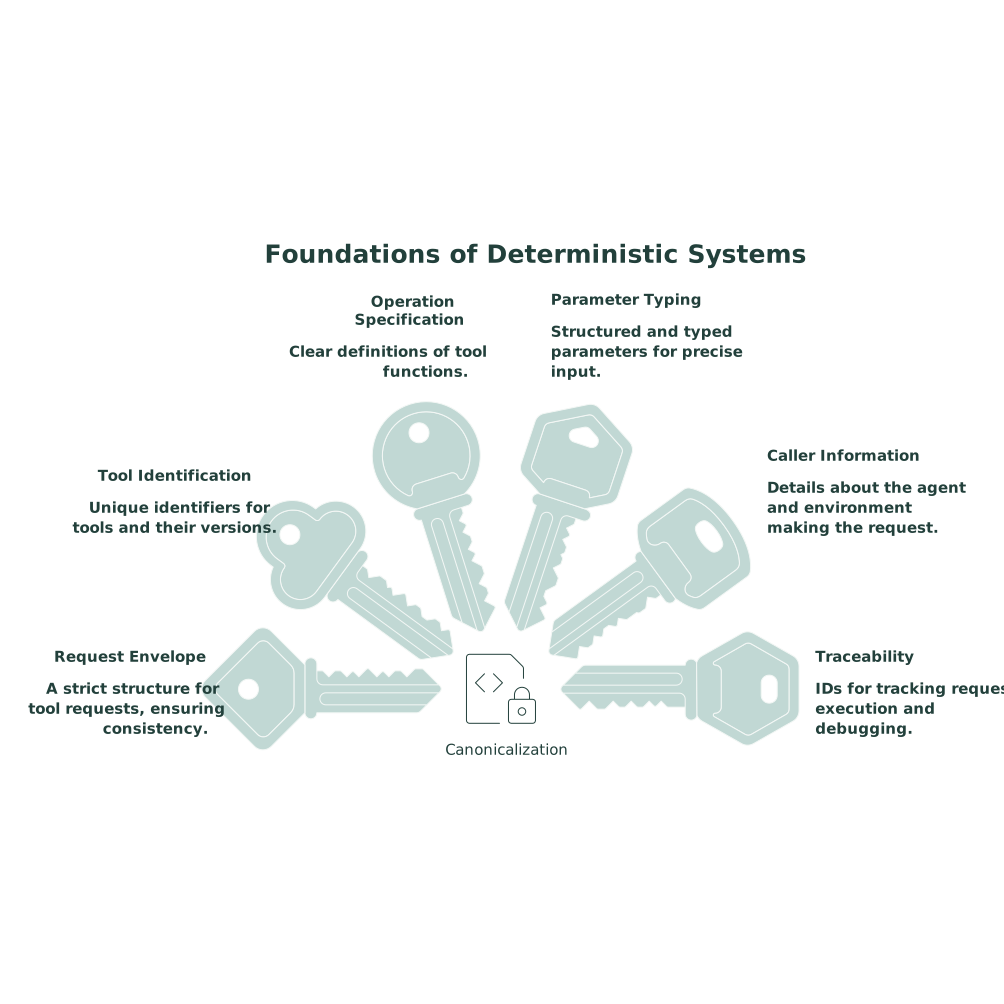
Canonicalization rules for the envelope should be explicit and stable:
- Sort object keys lexicographically before hashing or caching.
- Normalize whitespace and Unicode (NFC) for strings that will be compared.
- Represent timestamps in one format (ISO 8601 with UTC “Z”).
- Represent decimals consistently (fixed scale where business logic requires it).
- Reject unknown fields instead of silently accepting them.
For HTTP tools, also normalize headers and query parameters. Lowercase header names, remove hop-by-hop headers, and decide which headers are meaningful for cache keys (authorization usually is, but maybe only by tenant).
Canonicalizing tool responses
Responses are harder because you don’t control upstream formatting. The proxy should canonicalize the body before hashing and optionally before returning it to the agent. Common techniques:
- Canonical JSON serialization: stable key ordering, no insignificant whitespace.
- Normalize floats: avoid binary float artifacts by converting to strings or fixed decimals for known fields.
- Remove or bucket nondeterministic fields: request_id, server_time, trace ids.
- Normalize arrays only when ordering is not semantically meaningful (otherwise keep order).
Be cautious: over-canonicalizing can hide real changes. The safest approach is to define per-tool, per-operation schemas that mark fields as deterministic, allowed-nondeterministic, or forbidden.
Idempotency keys to prevent repeated side effects
Agents retry. Networks fail. Users double-click. Without idempotency, a “create” operation can run twice and you end up with duplicate tickets, charges, emails, or data mutations.
What to key on
An idempotency key should represent the business intent, not the HTTP request bytes. A practical formula is:
- Tenant/workspace id
- Tool + operation
- A canonicalized subset of params that define uniqueness
- A time window when appropriate (e.g., “per day”)
The proxy can accept a client-provided key (recommended for end-to-end traceability) and also derive a server-side key to detect missing or malformed keys.
Storage, TTLs, and replay rules
Idempotency requires storage. For each key, store:
- Request hash (canonical request bytes hashed)
- Response hash and canonical response
- Status (in-progress, succeeded, failed)
- Expiry (TTL aligned to business risk)
On replay, enforce strict rules: if the same key is used with a different canonical request hash, reject it. That’s the difference between idempotency and “best effort de-dupe.”
Response hashing and tamper-evident logging
Hashing makes a response verifiable later. Tamper-evident logging makes it hard to alter history without detection.
What to hash
Hash the canonical request and canonical response separately, then hash an envelope that includes both plus metadata. Example fields:
- request_canonical_hash
- response_canonical_hash
- tool_name, tool_version, operation
- timestamp (proxy-issued)
- previous_log_hash (to form a chain)
This creates a hash chain: each record commits to the previous one. If someone edits an old entry, the chain breaks.
Where to store the evidence
Store logs in an append-only system when possible. Even if you use a standard datastore, the hash chain still provides detection. For higher assurance, periodically anchor the chain head into a separate system (a different storage account, or a scheduled export) so an attacker has to compromise multiple places to cover tracks.
Determinism vs privacy and redaction
Deterministic logging can accidentally preserve sensitive data. The proxy is also the right place to apply consistent redaction rules before persistence. The key is to redact in a way that remains searchable and debuggable: replace PII/PHI with stable tokens (format-preserving or keyed hashes) so repeated values map to the same placeholder. If you’re building governance around this, the same mindset appears in this internal guide on redacting PII and PHI without losing searchability.
Operational details that make the system hold up
Schema-first tooling
Define JSON Schemas (or protobuf) for each tool operation. Canonicalization and redaction become predictable when fields are typed and validated. Reject invalid inputs early, and record validation failures in the tamper-evident log.
Versioning and backwards compatibility
Canonicalization rules are part of your public contract. Version them. If you change how a field is normalized, bump the tool_version or canonicalization_version so historical hashes remain meaningful.
Handling inherently nondeterministic tools
Some tools are nondeterministic by nature (search, “latest”, live pricing, time). For these, determinism means you can prove what you saw, not that you’ll see it again. Treat the canonical response and its hash as the artifact to reproduce decisions, and log enough context (query, filters, locale) to explain why two runs differed.
Implementation checklist
- Force all agents through one proxy entry point.
- Canonicalize requests and responses with explicit schemas.
- Require idempotency keys for side-effecting operations; reject mismatches.
- Hash canonical payloads; build a hash chain for tamper evidence.
- Redact sensitive fields before persistence using stable tokens.
- Version your canonicalization rules and tool contracts.