
Why cold-start is the hardest moment for public agent endpoints
Public AI agent endpoints have a predictable failure mode: the first time you expose an unauthenticated or lightly authenticated API, you have no user history, no stable traffic baseline, and no reliable signals to separate legitimate experimentation from automation. Attackers know this. They probe early to find cost-amplifying prompts, tool-call paths that hit paid services, and weak limits that let them scale.
A cold-start defense is the set of controls that work when you have almost no reputation data. It prioritizes progressive trust (earn access over time), reputation scoring (accumulate signals), and edge challenges (prove you’re a real client before expensive work happens). Done well, this reduces abuse without blocking real users.
Progressive trust as a default access model
Progressive trust means the “first request” experience is intentionally constrained. As a caller demonstrates good behavior, you expand quotas, reduce friction, and allow more powerful tools. This is different from a static rate limit. It is a policy ladder.
Define trust tiers that map to real risk
Start with 3–5 tiers you can explain to engineering and support:
- Tier 0 (unknown): anonymous, no prior signals. Small request budget, strict tool allowlist, low max token/output caps.
- Tier 1 (verified client): passed an edge challenge and basic API hygiene checks. Higher burst, moderate daily cap.
- Tier 2 (identified): account + verified email/domain, stable traffic, low anomaly score. More tokens, more tool access.
- Tier 3 (trusted): paid plan or vetted partner. Highest caps, fastest path to tool execution.
The key is that each tier changes something expensive: model tokens, tool calls, external HTTP requests, or access to privileged actions.
Make the first 60 seconds cheap by design
Cold-start abuse often targets cost. Your Tier 0 policy should make it difficult to trigger expensive operations:
- Cap output tokens and enforce short responses until trust increases.
- Block or sandbox tool calls (web browsing, outbound fetch, database writes) for unknown clients.
- Prefer “explain what you would do” over “do it” until identity and intent are clearer.
- Require idempotency keys for mutating operations to prevent replay loops.
This doesn’t need to be hostile. It can be framed as “trial mode” with a clear upgrade path.
Reputation scoring that works before you have accounts
Reputation is not only “user reputation.” For public endpoints, you need a requester reputation that can start with network and behavioral signals, then attach to an account once a caller identifies themselves.
Use a composite identity, not a single key
Attackers rotate IPs and user agents. Legitimate users also appear behind NATs and corporate gateways. Treat identity as a bundle:
- IP and ASN (good for coarse risk, not for hard blocking)
- JA3/JA4-style TLS fingerprinting or equivalent network fingerprints
- Client hints and header consistency
- API key (when present) and key age
- Session cookie or signed token for browser-based agent UIs
The scoring model should tolerate change in one attribute while still linking likely-related traffic.
Score behaviors that correlate with abuse
Cold-start scoring should emphasize simple, explainable heuristics you can audit:
- Prompt similarity at scale: repeated near-duplicate prompts across many identities.
- High tool-call ratio: unusually frequent tool execution versus normal chat.
- Error shaping: systematic probing for limits (e.g., escalating token sizes, invalid tool names).
- Cost spikes: sudden increases in max tokens, long contexts, or expensive models.
- Traffic shape: perfect periodicity, synchronized bursts, or impossible human interaction timing.
Reputation shouldn’t just punish. It should route: low score triggers friction (challenge, lower caps), not necessarily a permanent block.
Persist reputation with privacy-aware logs
Reputation systems depend on retention. But agent traffic often contains sensitive data. Redact aggressively before storage, and keep only what you need to score behavior (counts, hashes, structural features). If your agent processes internal documents, align the logging plan with a redaction approach so you don’t lose operational searchability while protecting users. For a practical pattern, see the internal playbook on redacting PII and PHI without losing searchability.
Edge challenges to stop bots before they hit the model
The cheapest place to filter abuse is at the edge, before you allocate model tokens or spin up tool execution. Edge challenges are proofs that a client is likely real, or at least that it can sustain computational and interaction costs comparable to what it is asking your system to spend.
Pick challenge types that match your client surface
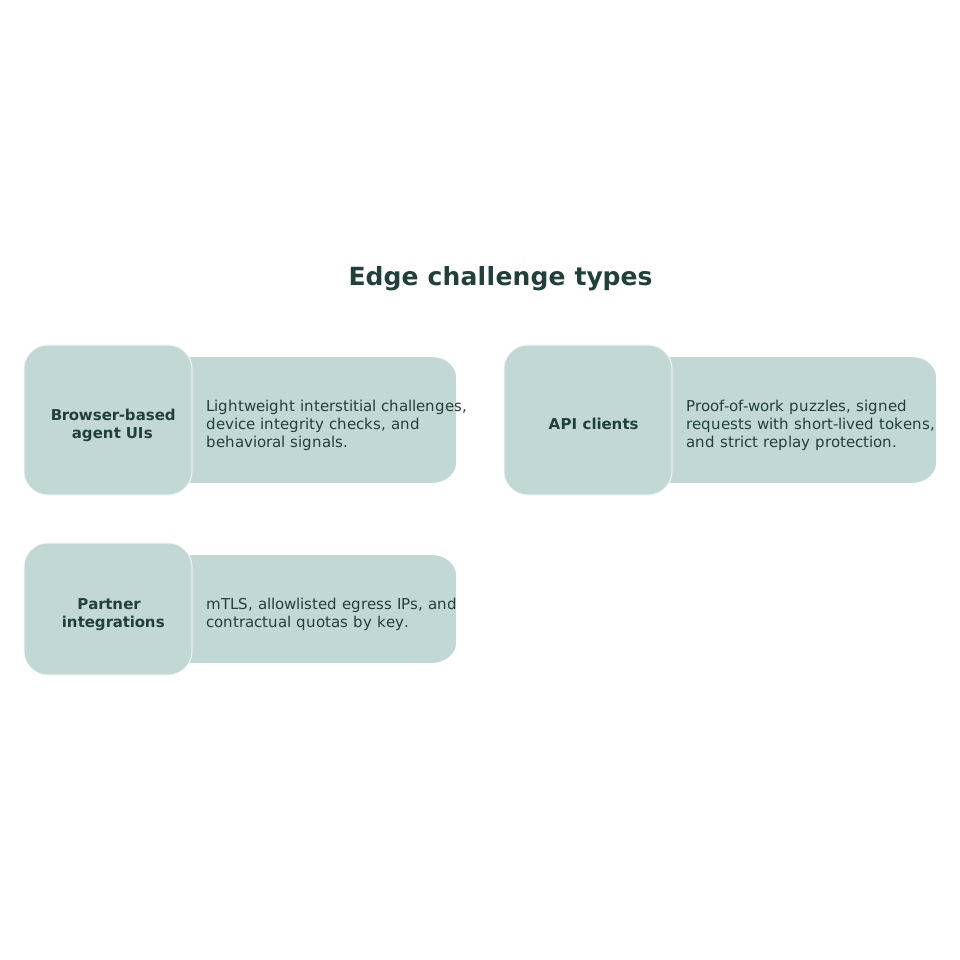
- Browser-based agent UIs: lightweight interstitial challenges, device integrity checks, and behavioral signals.
- API clients: proof-of-work puzzles, signed requests with short-lived tokens, and strict replay protection.
- Partner integrations: mTLS, allowlisted egress IPs, and contractual quotas by key.
Challenges should degrade gracefully. For example, a known-good API key might bypass proof-of-work, while an unknown client must solve it before receiving full throughput.
Use challenge outcomes as reputation signals
Don’t treat a challenge as a binary gate. Feed results into scoring:
- Pass rate over time
- Latency to solve (bot farms often show distinctive patterns)
- Consistency across sessions
This helps progressive trust feel smooth for real users while tightening quickly on automation.
Designing tool access to be abuse-resistant
Agents become costly and risky when they can call tools: fetch URLs, send emails, write to databases, or trigger workflows. Cold-start defense should assume tool abuse will be attempted immediately.
Default-deny tools, then unlock with trust
Start unknown clients with a minimal tool allowlist. For example:
- Allow read-only tools with strict timeouts and response-size limits.
- Block outbound network calls unless the destination is on an allowlist.
- Require explicit user confirmation for actions with real-world impact.
As reputation improves, expand the allowlist and concurrency. This mirrors how you’d roll out permissions in a Zero Trust system.
Put quotas on the expensive dimension
Rate limits are necessary, but cost controls should align to what you pay for:
- Token budgets per minute/day per identity
- Tool-call budgets (count and concurrency)
- Outbound egress budgets (requests and bytes)
- Queue timeouts and max execution time for long-running tool chains
If you measure only requests per second, attackers will optimize within that constraint. Measure what hurts.
Operationalizing the system on an edge-first platform
Cold-start defense is easiest when edge security, traffic controls, and compute live together. A practical approach is to combine WAF and bot signals, programmable edge logic, and per-identity quotas so that suspicious traffic is challenged or shaped before it reaches the agent runtime. This is a natural fit for a network and developer platform like cloudflare.com, where you can put enforcement close to the requester and keep expensive inference paths behind stricter gates.
Rollout plan that avoids false positives
- Week 1: instrument cost and behavior metrics; enforce conservative token caps for Tier 0.
- Week 2: add edge challenges for anomalous traffic; start reputation scoring in “observe” mode.
- Week 3: turn on progressive trust tiers; unlock higher limits only after stable behavior.
- Ongoing: review abuse incidents as policy tests, not one-off emergencies.
When you update policies, document the intent and the tradeoff so product, security, and support stay aligned.
What “good” looks like in practice
A resilient public endpoint feels boring to abuse. Unknown clients can try the agent, but can’t cheaply scale it. Legitimate developers quickly learn the rules: solve a challenge once, keep prompts within trial limits, then identify themselves to earn higher throughput. Meanwhile, the system continuously converts edge outcomes and behavioral telemetry into reputation, keeping progressive trust accurate even when identities shift.