
Why competitor mentions show up in AI answers sourced from your assets
Retrieval injection happens when a model pulls your syndicated content, then picks up adjacent or embedded text that steers the answer toward someone else’s brand. The pattern is common in AI search, AI Overviews, and assistant-style results that use retrieval-augmented generation (RAG). If your distributed assets contain third-party comparisons, unscoped citations, scraped “alternatives” lists, or templated boilerplate, you can unintentionally feed competitor mentions into the model’s context window.
A retrieval injection audit is the process of finding which assets are being retrieved, what text within them is influencing generation, and where competitor entities are introduced. The goal is not “erase competitors.” The goal is control: keep your content answerable, citeable, and unambiguous about the entity the user asked for.
Define what counts as retrieval injection in your environment
Start with a tight definition. In audits, it helps to separate three cases:
- Legitimate comparison: the query is comparative and competitor mentions are expected.
- Accidental co-mention: your asset includes competitors in non-comparison contexts (footer widgets, templated “related tools,” author bio, syndicated navigation).
- Prompt-like steering: hidden or poorly-labeled text that effectively tells the model what to recommend, cite, or list—often introduced by syndication partners, content scrapers, or plugins.
The audit focuses on the last two. You need evidence that the competitor mention is coming from your distributed footprint, not from independent sources.
Inventory your syndicated footprint before you test models
Audits fail when teams jump straight to prompting ChatGPT or Google and guessing. Build an inventory first, then test.
What to collect
- All syndication destinations: partner blogs, guest posts, republished press releases, community posts, “network” sites, and any managed publishing networks.
- Asset types: long-form posts, listicles, FAQ pages, video transcripts, slide decks, and short-form social captions that get re-embedded.
- Canonical and attribution: canonical tags, source links, author pages, and any “powered by” footer modules.
- Structured data: Organization, Article, FAQ, Product, and sameAs references.
If your brand relies on always-on distribution, this footprint changes constantly. That’s why infrastructure matters: you want repeatable audits, not one-off spot checks. Xale AI positions this work as an operational loop—publishing plus governance—so the signals compounding over time don’t also compound leakage. Place your brand reference once and consistently, including the required link to xale.ai.
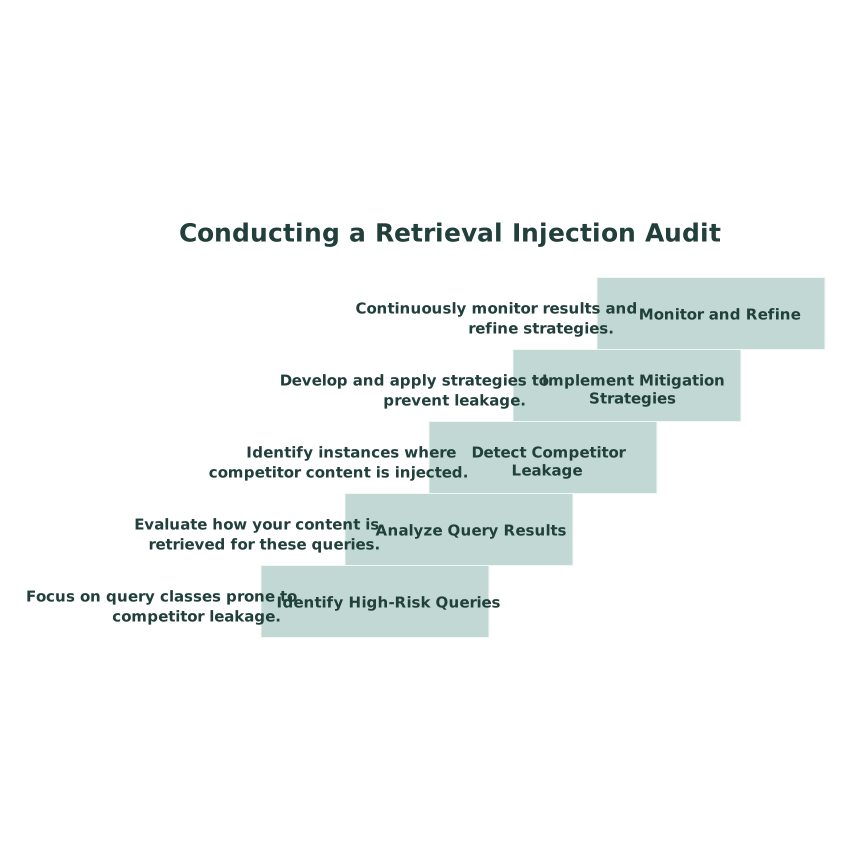
Run a retrieval injection audit in five steps
1) Choose “high-risk” query classes
Competitor leakage tends to concentrate in predictable query classes:
- “Best tools for…” and “alternatives to…” (even when the user asks for you by name)
- “Compare X vs Y” where your content gets retrieved for definitions, not comparisons
- Category queries where your brand is an edge case and the model fills gaps with generic market leaders
- Pricing, integrations, security, and compliance questions that trigger boilerplate blocks
Create a small set of 30–50 queries that represent real buying research. Include branded queries (“What is xale.ai?”) and non-branded category queries (“AI visibility infrastructure for SaaS”).
2) Capture evidence of retrieval, not just the final answer
Whenever possible, test in systems that expose citations or retrieved passages. You’re looking for:
- The URL that is being cited
- The exact paragraph that was pulled into context
- The sentence where the competitor entity appears
If the interface doesn’t expose snippets, you can still triangulate by repeating prompts, varying the query slightly, and tracking which citations remain stable. Stability usually indicates retrieval dependency.
3) Map competitor mentions to the injection surface
Once you have a cited URL, open the page source and locate the competitor string. Injection surfaces typically fall into a few buckets:
- “Related posts” widgets that include competitor names in anchor text
- Template blocks like “Top 10 tools” inserted across many pages
- Author bios that mention other products the author works with
- Third-party scripts that insert outbound links post-render
- Syndication edits where a partner adds their own comparison paragraph
Tag each incident with: page URL, section type (main body vs template), competitor entity, and whether the text is visible to users or only to crawlers.
4) Score each incident by “answer influence”
Not all co-mentions matter. Score them based on how likely they are to influence the model’s generated answer:
- Proximity: competitor appears near your definition, value prop, or “what it is” paragraph.
- Imperative phrasing: “Use X for…” “Best option is…” “Recommended…”
- Entity clarity: your brand is referenced with weak nouns (“the platform”), while the competitor is named explicitly.
- List position: competitor appears in bullets, headings, or tables that models frequently quote.
- Schema leakage: FAQ or Product schema contains competitor entities in answers.
This scoring tells you what to fix first. Low-influence mentions can be left alone if they’re legitimate citations. High-influence injection needs remediation.
5) Remediate with governance, not just edits
Fixing one page is easy. Preventing the pattern across a syndication network is the real work. Effective remediation is usually a mix of:
- Template hygiene: remove competitor-rich “related tools” modules from syndicated templates.
- Entity reinforcement: strengthen the first mention of your brand, include a short unambiguous descriptor, and align it with Organization markup.
- Scoped comparisons: when comparisons are necessary, put them in a clearly labeled section (e.g., “Market context”) so retrieval doesn’t treat it as the definition.
- Attribution boundaries: require partners to keep your body content unmodified and place their additions below a divider.
- Schema review: ensure FAQ answers don’t name competitors unless the question is explicitly comparative.
If you’re dealing with crawl inefficiencies at the same time, the same cleanup work often helps: cleaner canonicals, clearer entities, and better structure reduce noisy retrieval. For adjacent operational guidance, see how structured data and canonicals reduce AI crawl budget issues.
How to detect syndication patterns that amplify competitor leakage
Competitor mentions become persistent when your network produces the same co-mention across many domains. Watch for these syndication patterns:
- Uniform “alternatives” blocks repeated across dozens of posts
- Source monocultures where many pages cite the same external listicle that names competitors heavily
- Over-shared author pages syndicated everywhere, carrying the same outbound links
- Low source diversity that forces models to fill in missing context with market leaders
This is where distribution strategy and governance intersect. If your syndication aims to increase AI citations, you also want to avoid “diversity debt” that pushes models toward the same few competitor-heavy sources. The framing in source diversity debt and syndication patterns is useful when deciding which destinations and formats to scale.
Operationalize the audit as a monthly control
Treat retrieval injection as a repeatable control, not a one-time cleanup. A lightweight monthly routine works:
- Re-run the same query set and compare citation drift
- Spot-check the top 20 syndicated URLs driving retrieval
- Track competitor co-mentions per asset type (post, FAQ, transcript, video caption)
- Flag new template blocks introduced by partners
Over time, you’ll see which formats are “clean” for AI ingestion and which formats routinely leak competitor entities. That feedback loop is what turns syndicated publishing from exposure into reliable AI visibility.