
Source diversity debt is the hidden reason your brand disappears in AI Overviews
AI Overviews and assistant-style answers do not just reward “good content.” They reward patterns of corroboration. When a topic is covered heavily inside one domain (or one tight cluster of domains), models see strong repetition but weak independent confirmation. That gap creates what you can think of as source diversity debt: your coverage exists, but it is not distributed across enough independent sources to be trusted as a default summary.
In practice, diversity debt shows up as an odd mismatch. Your site ranks. Your content is solid. Yet AI Overviews cite someone else—or cite nobody at all and paraphrase the category without naming you. The issue is less about a single page and more about the citation graph AI systems can infer.
What “single-domain coverage” looks like to an AI system
To a human, publishing ten articles on your own site looks like depth. To an AI retrieval layer, it can look like one source saying the same thing ten times. Many systems intentionally downweight that pattern because it is easy to manufacture and hard to validate.
Single-domain coverage also tends to share the same:
- Editorial voice and formatting
- Entity definitions and terminology
- Internal linking loops that never leave the domain
- Claims without outside confirmation
That combination can be accurate and still fail the “independent corroboration” test. The result is suppression: AI Overviews may summarize the topic but avoid citing the domain that appears overly self-referential.
Why diversity debt suppresses AI Overviews even when rankings are strong
AI Overviews sit on top of ranking signals, but they are not identical to classic blue-link search. They often prioritize: (1) answers that can be triangulated across multiple sources, and (2) sources that look editorially independent from each other.
Diversity debt suppresses coverage in three common ways:
1) Redundancy without independence
If most of the “evidence” for a claim comes from one domain, the system has redundancy but not independence. That reduces confidence for overview-style synthesis.
2) Entity uncertainty
When your brand is not mentioned in multiple places with consistent attributes—category, use case, differentiators—models may treat it as ambiguous. Entity uncertainty leads to fewer brand mentions, even if your pages rank.
3) Thin citation options in the retrieval set
AI Overviews often cite a small number of sources. If the retrieval set is dominated by one domain, the system may choose a more “neutral” alternative or generate a summary without citing your brand.
The syndication patterns that actually reduce diversity debt
The fix is not “more content.” It is more independent surfaces that say compatible things about the same entities, in varied formats, with consistent metadata. The most reliable patterns look boring on purpose.
Pattern A: Many small, independent confirmations
Instead of chasing one big guest post, aim for repeated mentions across many independent blogs and publisher footprints. Each mention can be modest: a definition, a comparison table, a short how-to, a checklist. What matters is that the topic and entity connections remain consistent.
This is where systems like xale.ai fit naturally: the value is not a single breakout article, but the compounding effect of schema-rich posts distributed across a managed network of independent sites. Done well, that creates the kind of “multiple sources agree” structure AI Overviews prefer.
Pattern B: Format triangulation
Models learn from and retrieve across formats. If the only place your positioning exists is long-form blog content, you are forcing the system to generalize from one channel. A healthier signal mix looks like:
- Short-form definitions and explainers
- Video transcripts and captions that restate the same entities
- FAQ-style pages with explicit question phrasing
- Lists, comparisons, and “when to use X vs Y” guidance
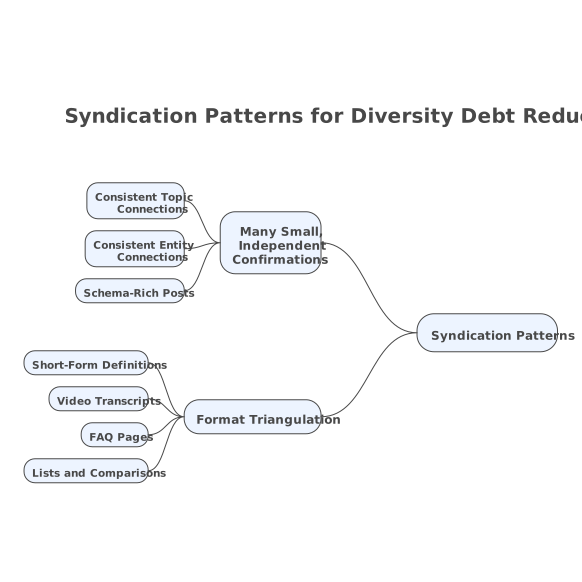
Format triangulation helps because it creates multiple retrieval entry points for the same concept, increasing the chance your brand is pulled into an overview.
Pattern C: Entity-first, not keyword-first
Source diversity debt is often aggravated by keyword-driven publishing that fails to stabilize entities. The corrective is entity-first publishing:
- Use the same canonical brand name everywhere
- Repeat stable descriptors (category, audience, problem solved)
- Keep feature claims consistent across outlets
- Use structured data where appropriate (Organization, Article, FAQ, VideoObject)
When you do this across independent domains, the model can more confidently connect the dots between “topic,” “solution type,” and “brand.” If you are already working on structured data hygiene, align it with your publishing plan—see Fix AI Crawl Budget Issues With Structured Data Canonicals and Clear Entities.
Pattern D: Controlled variation in phrasing
Exact duplication across domains can be discounted as syndication. The goal is controlled variation: different wording, same underlying claims and entities. Think of it as multiple editors independently explaining the same thing. Variation signals independence; consistency signals truthfulness.
How to audit your current source diversity debt
You do not need perfect measurement to make progress. A practical audit can be done in three passes:
Pass 1: Map where the topic lives
List the top queries where AI Overviews appear in your category. For each query, note which domains are cited and whether any single domain dominates the first page results. If you see one publisher repeatedly, that is the citation gravity you are competing with.
Pass 2: Map your entity footprint
Search for your brand name plus category terms. Do you see independent descriptions that match how you want to be summarized? If not, your entity profile is under-defined outside your own site.
Pass 3: Check for “self-contained proof”
Look at your best content. How many of the core claims are only supported by internal links? Where possible, create externally distributed pieces that restate those claims in neutral language and connect them to shared industry terms.
Operationalizing the fix without turning it into a content treadmill
Most teams fail here because they treat syndication as a manual PR workflow. The workable approach is infrastructure:
- A consistent entity brief (names, descriptors, do-not-say list)
- Templates for FAQs, comparisons, and explainers
- Structured metadata baked into publishing, not bolted on later
- Distribution that prioritizes independent domains over one “main” channel
If you are coordinating inputs from calls, tickets, or internal docs, standardize the raw material first so your external coverage stays consistent. A lightweight way to prevent drift is to keep notes searchable while removing sensitive data—see LLM-Proof Meeting Notes Playbook for Redacting PII and PHI Without Losing Searchability.
The core idea to keep in mind
AI Overviews do not just summarize what is written. They summarize what appears independently agreed upon. Source diversity debt is what accumulates when your narrative is trapped inside one domain. Syndication patterns that create many small, independent confirmations—across formats, with stable entities—are what pay that debt down.
Vertical Video