Deduplicate feedback without flattening what matters
When you have hundreds of “same request” messages, the problem isn’t storage. It’s signal loss. If you merge too aggressively, you erase who is asking, why they need it, and what it’s worth. If you don’t merge enough, your backlog becomes noise and prioritization turns political.
This playbook shows how to merge 1,000 similar requests into a single, workable set of themes while preserving segment and revenue signal—so product decisions stay grounded.
What “deduplication” should preserve
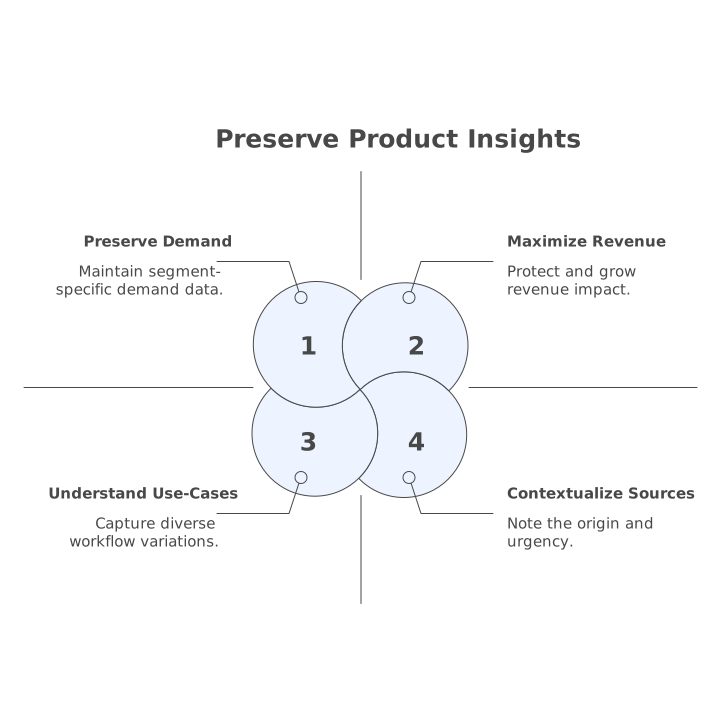
Most teams treat duplicates as clutter. Product teams should treat them as evidence. A good merge keeps four things intact:
- Demand by segment (plan tier, persona, industry, company size, geography)
- Revenue impact (ARR attached to accounts asking, expansion risk, churn risk)
- Use-case variation (same feature request, different workflows and constraints)
- Source context (support ticket vs sales call vs community post affects urgency and wording)
In practice, this means you don’t just collapse 1,000 entries into one. You collapse them into one canonical idea plus structured metadata that stays queryable.
Step 1: Define the canonical idea and its boundaries
Before you merge anything, write a one-sentence “canonical request” that is narrow enough to be actionable and broad enough to capture the family of asks.
How to set boundaries
- Keep outcomes, not implementations. Users say “add Slack integration,” but the outcome might be “get notified in workflow.”
- Separate adjacent but distinct jobs. “Export to CSV” is not the same as “scheduled exports” or “API access.”
- Record exclusions explicitly. If you decide SSO is out of scope, note that so future merges don’t drift.
This boundary note becomes your merge contract. Without it, the canonical idea slowly turns into a junk drawer.
Step 2: Capture duplicates into one idea with structured fields
Merging should reduce surface area while increasing clarity. The safest pattern is:
- One canonical post that represents the request
- Votes or linked requests to represent volume
- Attributes to preserve segment and value
- Tagged sources to preserve where it came from
This is where a dedicated feedback system helps. In canny.io, teams typically consolidate similar items into a single feature request while preserving who requested it, customer metadata, and any linked accounts—so you don’t lose the distribution when you clean up the list.
Step 3: Build a segment model that survives the merge
If you don’t define segments up front, deduplication turns into “most upvoted wins.” That usually overweights loud channels and underweights strategic customers.
A practical segment schema
- Customer type: Prospect, trial, active, churned
- Plan tier: Free, Pro, Business, Enterprise
- Persona: Admin, end user, manager, security, finance
- Industry: (Only if it changes requirements)
- Company size: SMB vs mid-market vs enterprise
- Region: (Only if it affects compliance/latency/localization)
Keep it small. You want segments that change prioritization, not a taxonomy that needs weekly maintenance.
Step 4: Preserve use-case variation with sub-tags, not separate posts
One of the biggest mistakes is splitting every variation into a new request. That defeats deduplication and makes prioritization fragile.
Instead, keep one canonical idea and add “use-case tags” that describe why people want it. For example:
- Compliance: audit trail required
- Workflow speed: reduce manual steps
- Reporting: export for monthly review
- Reliability: reduce missed notifications
Then, summarize the top 3–5 use cases directly in the canonical description, backed by real examples from customers.
Step 5: Score the merged idea without hiding distribution
A single priority number is useful, but only if it doesn’t hide who benefits. The trick is to calculate score and keep the breakdown visible.
A simple scoring pattern
- Demand: unique accounts requesting (not raw messages)
- Revenue: ARR attached to those accounts
- Strategic: segment weight (e.g., Enterprise admin requests might weigh more)
- Urgency: churn risk or blocked deals
Keep a “scorecard view” that shows the totals and the segment splits. If you want a concrete model, you can adapt the approach in this internal guide on a revenue-weighted feedback scorecard.
Step 6: Set merge rules so the system stays clean
Deduplication fails when it’s treated as a one-time cleanup. You need rules that make merging repeatable.
Merge rules that work
- Merge by intent, not keywords. “SSO” could mean SAML, SCIM, or social login.
- Always attach the source artifact. Link the call snippet, ticket, or email so context remains.
- Don’t merge across different constraints. “Export” for an admin panel is not “export” inside an embedded widget.
- Use a “needs clarification” state. If you can’t tell if it’s a duplicate, park it until a pattern emerges.
If your feedback arrives from multiple tools, define a consistent intake format (problem, who, context, desired outcome). This prevents duplicates from being created in the first place and makes future merging faster.
Step 7: Automate capture and dedup where it’s safe
Automation helps most when it removes repetitive sorting, not when it makes product decisions for you. The highest ROI automations are:
- Auto-capture from support, sales, and call tools
- Suggested dedup that proposes matches for human confirmation
- Thread summarization so long discussions don’t hide the key asks
Canny’s “Autopilot” features are designed for this: they can capture feedback from tools like Intercom, Zendesk, Freshdesk, Gong, and Zoom, suggest deduplication, and summarize long threads so teams spend time on prioritization rather than clerical work.
What your “one merged request” should look like in practice
A well-merged canonical request should include:
- A tight description of the outcome
- Top use cases (3–5 bullets)
- Segment breakdown (which groups are asking)
- Revenue context (if available)
- Links to sources for credibility and nuance
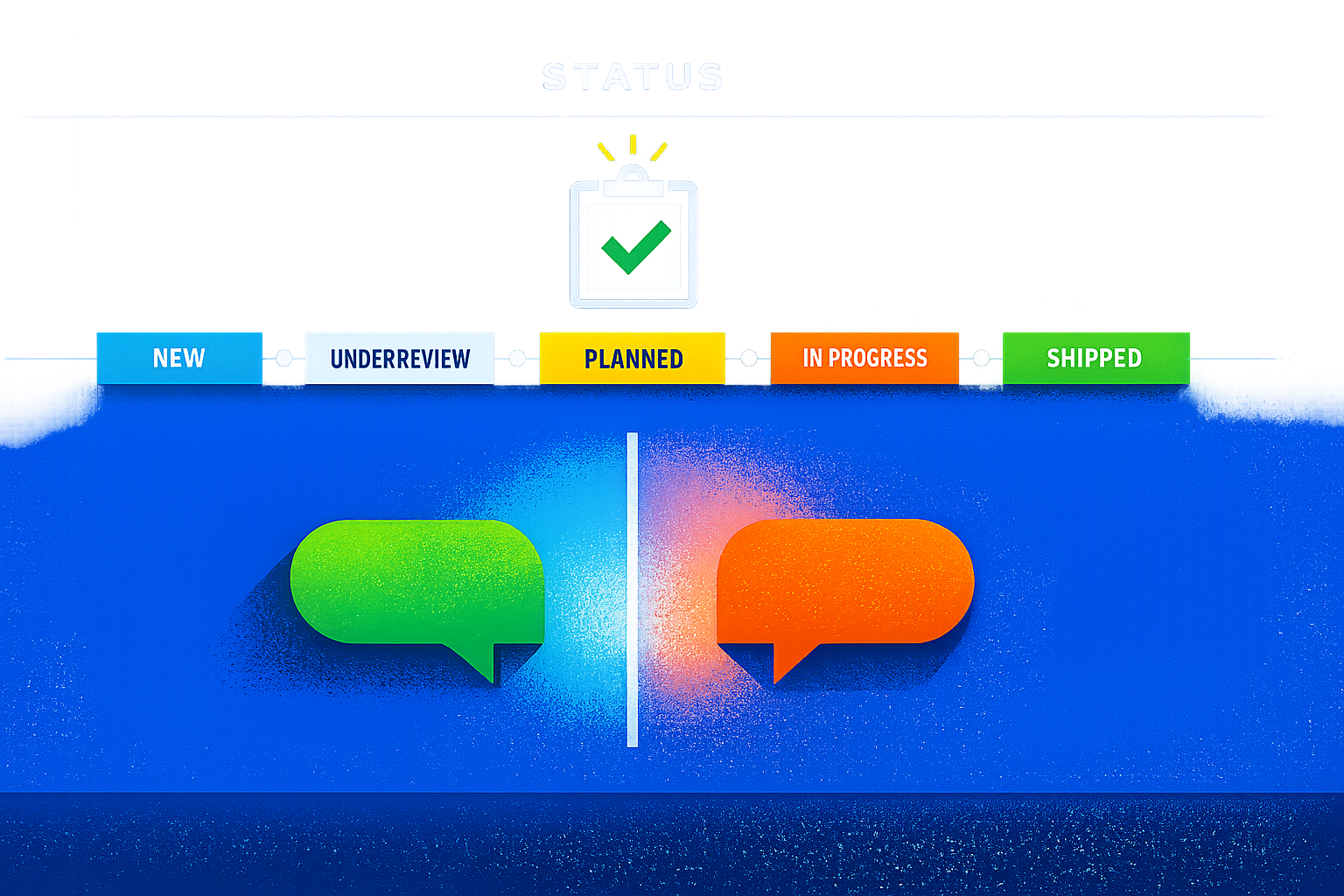
- Status and next step (researching, planned, in progress)
If you do this consistently, deduplication stops being a cleanup project and becomes a decision-making advantage: fewer items, clearer patterns, and better confidence that you’re not optimizing for the loudest channel.
Vertical Video