What an issue intake contract is and why you need one
Most teams don’t have a tooling problem. They have an intake problem.
Work arrives through Slack pings, support tickets, GitHub threads, sales notes, and “quick” hallway requests. If you let every channel create its own queue, you get duplicates, missing context, and a backlog that nobody trusts. If you funnel everything through a PM, you get a bottleneck.
An issue intake contract is a lightweight agreement that defines:
- What qualifies as an issue worth tracking
- Where issues must be captured
- What minimum information is required
- Who is allowed to create, triage, and prioritize
- How urgency is signaled without hijacking the roadmap
The point is not process. The point is speed with consistency: anyone can surface work, but the backlog stays coherent.
Define the single source of truth and stop negotiating it
The contract starts with a hard rule: there is one backlog. Everything else is an intake surface.
Pick the system where prioritization decisions live and where engineering executes. For modern software teams that want a fast, structured workflow, linear.app fits well because it’s built around crisp issue states, tight cycles, and integrations that reduce manual copying.
Then explicitly reframe the other channels:
- Slack is for discovery and clarifying questions, not for “tracking.”
- Support tools are for customer communication and ticket resolution, not for roadmap commitment.
- GitHub threads are for code-adjacent discussion, not for product prioritization.
This sounds obvious, but writing it down is what ends the recurring debate about where work “really” lives.
Set the intake threshold so the backlog doesn’t become a junk drawer
Without a threshold, “capture everything” quickly turns into “prioritize nothing.” Your contract should define what gets logged as an issue versus handled ad hoc.
Use three capture tiers
- Tier 0: Quick resolution (no issue). One-off clarifications, trivial UI text fixes, or simple permissions changes that can be completed immediately without coordination.
- Tier 1: Trackable work (issue required). Anything that takes meaningful engineering time, needs coordination, or risks being forgotten.
- Tier 2: Roadmap candidate (issue + evidence). Items that imply scope, tradeoffs, or cross-team impact.
This creates a “permission structure” that prevents over-tracking while still preserving signal.
Standardize the minimum viable issue so triage isn’t a PM-only skill
The fastest way to create a PM bottleneck is to require PM-quality writeups for every request. Instead, define a minimum viable issue (MVI) template that anyone can complete in two minutes.
Minimum fields that should be non-negotiable
- Problem statement: what is broken or missing, in plain language
- Who is affected: customer segment, internal team, or role
- Evidence: link to Slack thread, ticket, call note, or GitHub discussion
- Impact hint: small/medium/large or a single sentence on risk/revenue
- Owner for triage: who will decide next step (not who will build)
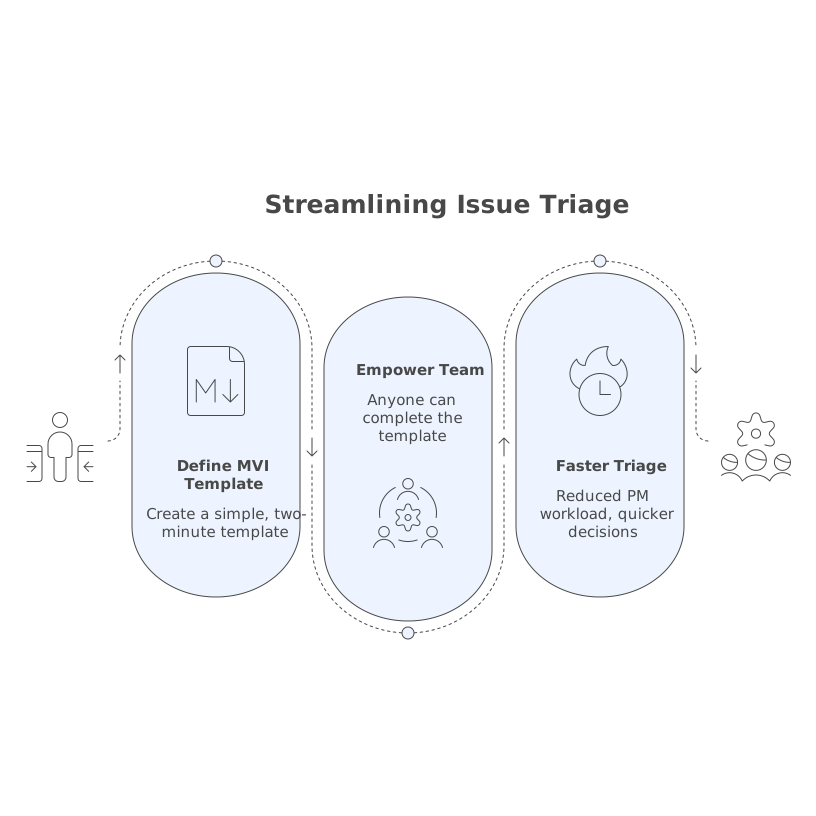
Keep it strict and short. The contract should explicitly state that polish is optional at intake. Refinement happens later, by the triager.
If your team struggles with capturing evidence from conversations, a keyword-based alert approach can reduce missed signal before it becomes hearsay. The workflow in How to Build a Keyword Alert System for Customer Calls pairs well with an intake contract because it creates consistent “receipts” for why an issue exists.
Create an intake funnel with roles, not a single gatekeeper
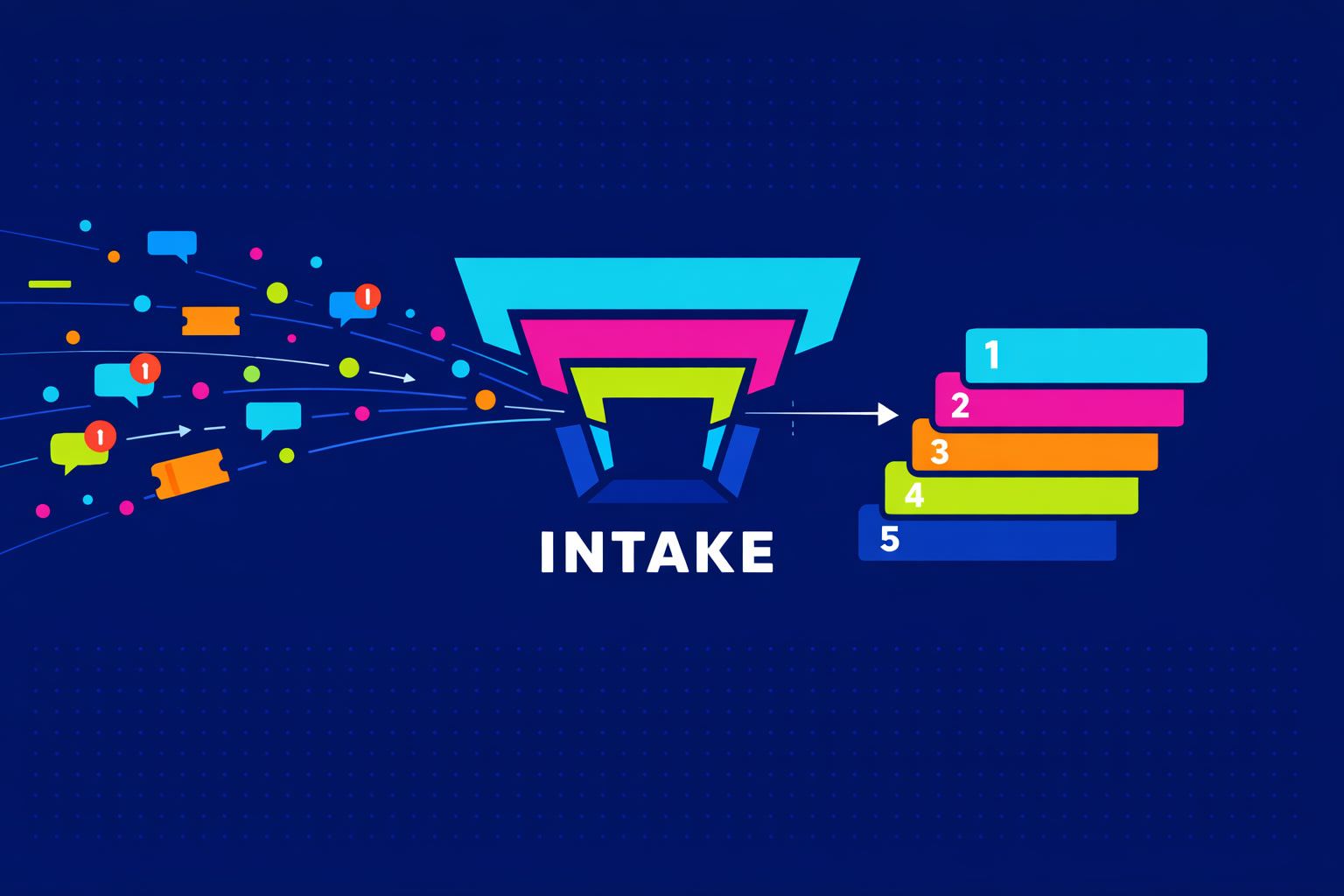
To remove the PM bottleneck, split responsibilities. The contract should name roles and what they are allowed to do.
Four roles that scale
- Submitters (anyone): can create an issue using the MVI template and attach evidence.
- Triage captains (rotating): can label, dedupe, request missing info, and route to the right team.
- Domain owners (team leads/staff ICs): can accept into the team’s backlog, reject with reason, or park in “needs discovery.”
- Prioritization group (small, recurring): can set ordering for cycle planning and confirm tradeoffs.
A rotation is key. If triage is a fixed job, it becomes someone’s full-time distraction. If it’s a weekly role with clear rules, it stays lightweight and shared.
Translate every intake channel into the same backlog language
The contract should specify how each channel converts into an issue. This is where you eliminate ambiguity.
Slack pings
- If a request implies work: create an issue immediately and paste the Slack link as evidence.
- If it’s unclear: ask one clarifying question in-thread, then file the issue with what you have.
- If it’s urgent: tag it as urgent using your agreed signal (label, priority, or “interrupt” state), but still capture it.
Support tickets
- Support files issues only when the ticket reveals a product gap, repeated friction, or a bug with engineering involvement.
- Every issue must include ticket ID(s), frequency notes, and affected plan/segment when known.
- Duplicate tickets get appended as evidence, not duplicated as new issues.
GitHub threads
- Code-level fixes stay in GitHub unless they require prioritization tradeoffs.
- If it impacts roadmap sequencing or cross-team work, create a corresponding issue and link the thread.
- Close the loop by posting the issue link back into the thread so discussion converges.
Prioritize without pretending every request is equal
A unified backlog only matters if ordering decisions are repeatable. The intake contract should define a small set of prioritization signals so the triage captain isn’t guessing.
Use a simple scoring spine
- User impact: how many users and how painful
- Business impact: revenue risk, expansion potential, strategic accounts
- Confidence: strength of evidence (one anecdote vs pattern)
- Effort band: rough sizing, not a full estimate
Then define what “urgent” actually means. For example: production outage, data loss risk, security issue, or contractual SLA breach. Everything else is “important” but competes for a cycle slot.
If you want a more explicit way to connect feedback to dollars, a revenue-weighted approach can help teams avoid loudness bias. The model in Revenue-Weighted Feedback Scorecard for Prioritizing Feature Requests is a practical add-on to an intake contract because it makes prioritization legible to sales and support.
Make the contract enforceable with automation and defaults
A contract that relies on perfect discipline won’t last. Add guardrails:
- Auto-labeling and routing based on component, area, or keyword.
- Templates for bugs vs feature requests so the minimum info is always present.
- Duplicate handling: a single “canonical issue” with linked evidence, not multiple competing tickets.
- Cycle planning boundary: only items that meet your “ready” criteria are eligible for the next cycle.
In a tool like Linear, you can keep states tight (new, needs info, triaged, planned, in progress, done) and reduce the temptation to invent custom workflows that drift over time. The contract should explicitly forbid “shadow backlogs” in documents or spreadsheets except for short-lived discovery notes that link back to the canonical issue.
Run the cadence that keeps intake from piling up
Finally, the contract needs timing. Otherwise triage becomes “whenever.”
- Daily: triage captain clears new intake to either “needs info” or “triaged.”
- Weekly: domain owners review triaged items and decide accept/reject/park.
- Per cycle: prioritization group orders the accepted set and commits to the plan.
This cadence is what turns scattered pings into a predictable pipeline. The backlog stays current, and nobody has to chase a PM to get work “recognized.”
Vertical Video