
Why reply rate can look suspicious during domain warmup
When you warm up a new sending domain, you’re trying to build a track record that mailbox providers (Gmail, Outlook, Microsoft 365, Yahoo) can trust. The usual advice is simple: send small volumes, get opens, get replies, avoid spam complaints.
The catch is that “too many replies” can look unnatural if the pattern doesn’t match real-world behavior. That’s the reply-rate paradox: replies are a positive signal, but an unusually high or overly consistent reply pattern can resemble automated conversation loops or coordinated activity.
Mailbox providers don’t publish exact thresholds. But they do evaluate engagement in context: who is replying, how fast, how repetitive the content is, whether threads look like authentic back-and-forth, and whether the same small set of accounts keeps responding in predictable cycles. The goal of warmup isn’t to manufacture a perfect reply rate. It’s to simulate credible, varied email behavior while your domain earns reputation.
What “suspicious conversation patterns” look like
Suspicion usually comes from uniformity. Real email traffic is messy. Automated warmups that over-optimize replies can accidentally remove that messiness.
Patterns that tend to raise flags
- Reply spikes at the same time every day (especially right after sending).
- Identical thread lengths (e.g., every conversation is exactly 2 messages long).
- Reused phrasing across multiple replies or repetitive, templated language.
- Closed networks where the same limited set of inboxes repeatedly engage with each other.
- Unnatural ratios such as extremely high replies compared to opens, or replies that appear without realistic read time.
- Thin conversations that look like “Thanks” and nothing else, repeated at scale.
These aren’t hard rules, but they are common failure modes. The safer approach is to design warmup so engagement looks organic: varied timing, varied participants, varied message types, and realistic thread behavior.
How to warm up a new domain without forcing replies
A strong warmup plan focuses on reputation building at three levels: domain, mailbox, and (if applicable) IP. Replies matter, but they’re only one part of the picture. You also want positive signals like opens, reading time, thread continuity, moving messages out of spam, and normal inbox actions.
1) Start with low volume and uneven daily pacing
Most deliverability issues during warmup come from doing too much too quickly. Ramp gradually, but avoid perfectly linear growth (e.g., exactly +10 emails every day). Real teams have uneven activity: lighter weekends, heavier mid-week, occasional dips.
Keep early sending constrained to your most controlled environment: one mailbox, one use case, one audience type. Once results stabilize, add more mailboxes and more segments.
2) Prioritize credible threads over maximum reply rate
Instead of aiming for “as many replies as possible,” aim for “believable conversations.” A believable pattern includes a mix of:
- Some emails that get opened and ignored.
- Some that get short replies.
- Some that get longer replies later in the day.
- Some that turn into a multi-message thread over several days.
This reduces the risk that your engagement looks manufactured. It also aligns more closely with what mailbox providers interpret as natural user behavior.
3) Vary reply timing and thread depth
Suspicion increases when replies happen in tight, repeated windows. Warmup engagement should have timing variance: minutes, hours, and sometimes next-day responses. Thread depth should vary too—some threads end quickly, others continue.
If your warmup system generates replies, ensure it doesn’t always reply immediately, doesn’t always reply once, and doesn’t always reply with the same sentence structure.
4) Rotate message intent and language
Repetitive language is one of the easiest signals to detect. Even if your emails are benign, identical phrasing across threads can look automated. Rotate tone and intent the way a real team would:
- Status updates (“Just checking in…”)
- Simple questions (“Does Tuesday work?”)
- Confirmations (“Got it, thanks.”)
- Clarifications (“To confirm, you meant…”)
Keep it professional and normal. Avoid gimmicky copy. Avoid stuffing links. During warmup, you’re building trust, not performance marketing.
5) Use multiple engagement signals, not just replies
Healthy reputation is supported by a broader footprint of positive interactions. Warmup should include opens and realistic “reading” behavior, plus occasional corrective actions like rescuing messages from spam when they land there.
This is where a warmup and deliverability platform can help because it can orchestrate varied, human-like engagement at scale. mailwarm is designed around generating authentic engagement signals across major providers using a large network of real inboxes, including opens, replies, and inbox interactions such as spam recovery actions. The practical advantage is that you can build reputation while avoiding brittle, repetitive patterns that trigger scrutiny.
Operational guardrails that prevent deliverability regressions
Align warmup with your real sending program
A common mistake is warming up with one pattern and then switching abruptly to a totally different pattern when campaigns start. If your real program will be outbound sales, your warmup should resemble that: smaller batches, personalized language, more natural reply distribution. If it’s product notifications, you’ll need to be even more careful—transactional-like traffic doesn’t naturally generate replies, so chasing replies during warmup can create a mismatch.
Keep complaint risk close to zero
Reply rate is meaningless if you accumulate complaints. During warmup, only send to recipients who expect to hear from you (or to controlled warmup networks). Keep your list hygiene tight, and don’t “test” questionable lists on a new domain.
Watch for metric mapping drift in deliverability reporting
Deliverability teams often compare dashboard numbers from multiple tools: mailbox provider postmaster data, ESP logs, CRM stats, warmup platform metrics. Definitions can drift (e.g., what counts as an “open” or “inbox placement”), which leads to wrong decisions.
If you’re consolidating reporting across platforms, it helps to standardize KPI definitions early. The same discipline described in keeping KPI definitions consistent across platforms applies here: decide what you trust, document it, and keep interpretation stable while you ramp.
A practical warmup checklist for the reply-rate paradox
- Ramp volume gradually and avoid perfectly linear daily growth.
- Accept “some ignores” and don’t force replies for every message.
- Vary timing so replies don’t always arrive instantly or on a fixed schedule.
- Vary thread depth so not every conversation ends after one reply.
- Rotate language to avoid repetitive templates across many threads.
- Use multiple positive signals (opens, realistic inbox behavior, spam recovery when needed), not replies alone.
- Keep reputation stable before scaling new mailboxes, new audiences, and new content types.
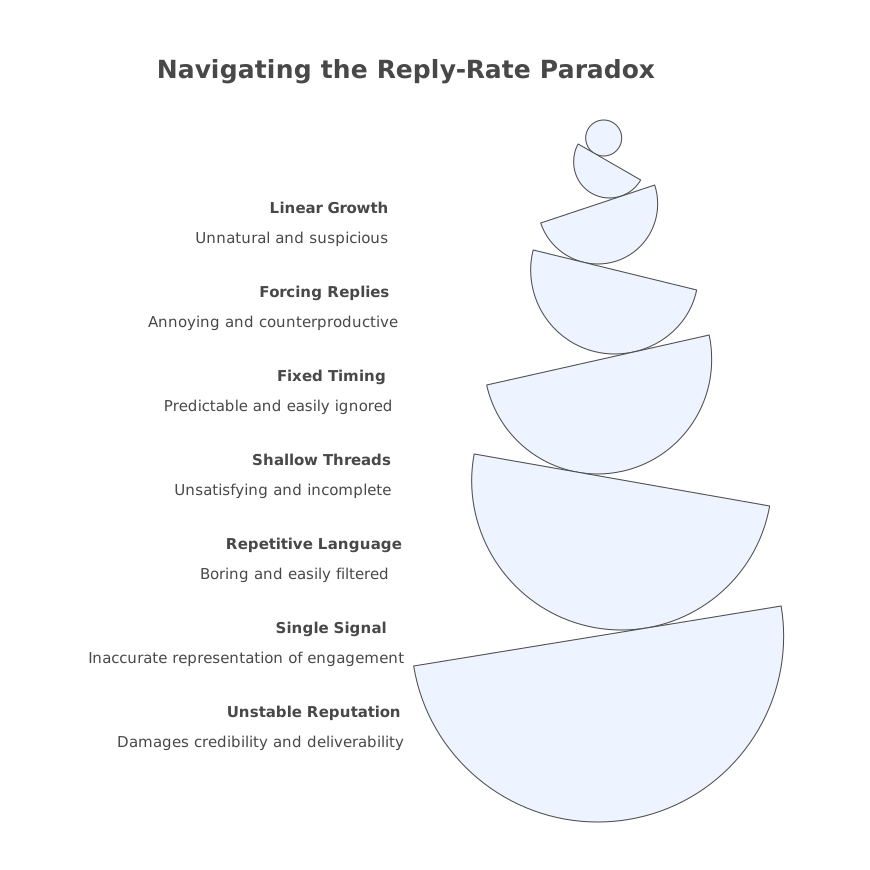
The paradox resolves once you treat reply rate as a supporting signal, not the target metric. Warmup works best when the activity looks like real communication, not optimized engagement.
Vertical Video