
Why LLM answers jump to the wrong category page
Deep site hierarchies create a common failure mode in AI answers: the model retrieves a high-authority category or hub page instead of the specific leaf page that actually answers the question. This happens even when the leaf page is indexed and internally linked.
Most retrieval stacks (LLM + search, RAG, AI overviews) do not “browse” your site like a human. They assemble evidence from snippets. If your hierarchy doesn’t leave strong breadcrumbs, the system can misclassify intent and route to the wrong level of the tree.
“LLM retrieval breadcrumbs” are the cues that keep a model anchored to the correct node in your information architecture. They include micro-structure (titles, headings, entity markers), macro-structure (breadcrumbs, hubs, parent-child linking), and technical signals (canonicals, structured data). The goal is simple: make the leaf page the most unambiguous match for the query, and make the category page clearly a navigator, not an answer.
What breadcrumbs mean in an LLM retrieval context
In classic UX, breadcrumbs help users navigate. For LLM retrieval, breadcrumbs are machine-usable hints that establish:
- Where the page sits in the hierarchy (parent category, subcategory, leaf).
- What the page is (definition, checklist, policy, tutorial, pricing, glossary).
- What the page is not (a general hub, an index, a tag archive).
- Which page is authoritative for the specific intent (leaf wins for “how”, category wins for “browse”).
If these are missing or inconsistent, the retrieval layer can “play it safe” and surface the category page, because it looks broader and more authoritative.
Design the hierarchy so the leaf page is the answer
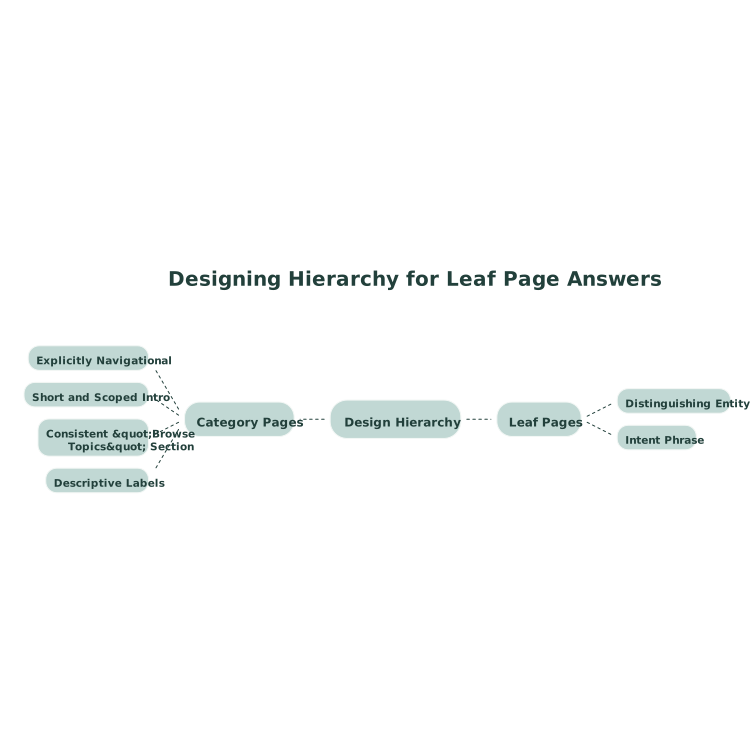
1) Make category pages explicitly navigational
Category pages often rank well and attract links. That’s fine. But they should read like hubs, not like partial answers. If the category page contains a long, detailed explanation, the model may treat it as the canonical answer and ignore the leaf pages.
Practical patterns:
- Keep the category intro short and scoped. Explain what the category covers and how to choose a subtopic.
- Use a consistent “Browse topics” section with descriptive labels.
- Link to the leaf pages using anchors that include the distinguishing entity or intent phrase.
2) Make leaf pages self-identifying
A leaf page should be unmissable in a chunked retrieval setting. That means the first 200–400 words must establish the page as the best answer to a specific question.
- Title: specific, includes the primary entity and the action (fix, configure, compare, troubleshoot).
- H2 near the top: a direct restatement of the question the page answers.
- Definition box: one short paragraph defining the concept in context.
- Scope line: what’s included and excluded.
This is not about keyword stuffing. It’s about reducing ambiguity for retrieval.
Build machine-readable breadcrumbs that survive chunking
Visible breadcrumbs that match the URL path
If your UI shows breadcrumbs, ensure they match the true hierarchy and the URL. Models often see this text in snippets and it helps disambiguate sibling pages.
Example pattern in-page:
- Home → Guides → LLM Retrieval → Retrieval Breadcrumbs
Then ensure the copy on the page mirrors the same taxonomy words. “Guides” in the breadcrumb but “Resources” in the header creates inconsistent signals.
Breadcrumb structured data
Implement BreadcrumbList structured data so crawlers can understand the parent-child chain even when the visual breadcrumb is not reliably parsed. Pair this with clean canonicals so the model doesn’t pick a filtered or parameter version as the primary node.
If you’ve had issues where AI systems burn budget on near-duplicate paths or ambiguous canonicals, align this work with a crawl and entity cleanup approach (the principles overlap with structured data canonicals and clear entities).
Stop “category hijacking” in retrieval results
Use intent fences on category pages
An intent fence is a short, explicit statement that prevents misclassification. Add a line early on category pages such as:
- “This page is an index of topics. For step-by-step instructions, choose a guide below.”
That sentence is a strong retrieval hint: it tells the model the page is not a procedural answer.
Use answer cues on leaf pages
Leaf pages should include clear answer cues that can be retrieved as standalone chunks:
- Numbered steps for “how-to” intents.
- Decision table for “choose between” intents.
- Checklist for “audit” intents.
- Short “Common mistakes” section for troubleshooting.
These cues increase the odds that the retrieved chunk is obviously the correct one, even without the surrounding navigation context.
Anchor internal links to reinforce the correct node
Internal linking is not just about PageRank flow. For LLM retrieval, anchors act like labels in a knowledge graph. Two rules help:
- From category to leaf: anchor should include the specific entity and outcome (not “Read more”).
- From leaf to category: link back with “Browse all X topics” so the leaf is framed as the answer and the category as navigation.
If your organization is already auditing how AI answers can drift into unwanted mentions or adjacent topics, treat hierarchy misrouting as part of the same discipline (see retrieval injection audits for a related mindset).
Validate breadcrumbs with real retrieval tests
You can’t fix what you don’t measure. Retrieval breadcrumbs should be tested the same way you would test SEO snippets: by querying and checking what gets pulled.
A basic test loop:
- Pick 20–50 queries that map to leaf pages (not categories).
- Record which URLs AI systems surface and whether they answer correctly.
- For failures, inspect the top-of-page text and headings on both the wrong category page and the correct leaf page.
- Add or tighten intent fences and answer cues. Re-test.
This is where an AI visibility workflow helps. lunem fits naturally into this process by monitoring how content is interpreted and surfaced across LLM-driven environments and by turning retrieval observations into structured actions you can apply to templates, breadcrumbs, and internal linking rules.
Template-level rules that prevent regressions
Deep hierarchies fail at scale when fixes are one-off. Put guardrails into templates:
- Category template: short intro, intent fence, curated list blocks, no step-by-step sections.
- Leaf template: strong top summary, explicit scope, “answer cue” block, and a single back-link to the parent hub.
- Taxonomy hygiene: avoid creating multiple near-identical category paths (tags, filters, archives) that compete.
When these rules are consistent, LLM retrieval has fewer ambiguous options. The hierarchy becomes a set of clear, reinforced paths: hubs for browsing, leaf pages for answers.