
Why AI tool calls fail quietly
Most internal APIs were built for human-written clients. A developer reads docs, tests edge cases, and usually notices when a payload is “almost right.” AI agents don’t. They produce plausible JSON that can be subtly wrong: a missing field that triggers a default, a unit mismatch, an enum value with the right meaning but the wrong spelling, or an array shape that passes parsing yet changes semantics.
That’s how you get silent data corruption. The tool call “succeeds,” logs look clean, and the system drifts until finance numbers, inventory states, or customer entitlements no longer match reality.
A schema-validated tool contract treats every agent-to-API interaction as an explicit, machine-checkable agreement. It rejects ambiguity early, surfaces actionable errors, and creates a paper trail that’s auditable.
What a schema-validated tool contract actually is
A tool contract is the combination of:
- Input schema: strict JSON Schema (or equivalent) for the request payload the agent is allowed to send.
- Output schema: strict schema for responses the agent is allowed to consume.
- Validation behavior: what happens on mismatch (hard fail, partial accept, coercion rules if any).
- Semantics: constraints that aren’t just types (units, allowed ranges, invariants, idempotency expectations).
- Versioning: how contracts evolve without breaking existing agents.
The goal is not “more documentation.” The goal is making invalid calls impossible to accept silently.
Silent corruption patterns to design against
1) Default traps
APIs often default missing fields. An agent omits currency, the service assumes USD, and you just misbooked a European invoice. Contracts should mark critical fields as required and refuse missing values.
2) Enum drift
An agent outputs "approved" instead of "APPROVED", or uses a synonym like "confirm". The server maps it to a fallback state. Schemas should use enum with no coercion, plus clear errors that the agent can route into a retry loop.
3) Unit and scale mismatches
amount can be dollars, cents, or micros. A “number” type doesn’t protect you. Encode units directly (amount_cents), use integer types where possible, and validate min/max ranges.
4) Shape errors that still parse
The agent sends an object where an array is expected, or nests fields one level too deep. JSON parsing succeeds, business meaning breaks. Use additionalProperties:false and strict schemas that reject unexpected keys.
Designing contracts that AI agents can reliably follow
Make schemas strict by default
- Use required for every field that changes behavior.
- Set additionalProperties to
falsefor objects. - Prefer integers over floats for money, counters, and IDs.
- Use oneOf/anyOf sparingly; ambiguity invites “close enough” outputs.
This feels rigid, but it prevents “creative” payloads from being accepted.
Encode semantics, not just types
Types catch syntax. Corruption happens at meaning. Add constraints:
- Regex patterns for IDs (
^cus_[A-Za-z0-9]+$). - Range limits for quantities.
- Explicit units in field names (
ttl_seconds). - Cross-field rules in the server validator (e.g.,
end_datemust be afterstart_date).
Return structured errors an agent can act on
A 400 with a string message is not enough. Return:
- A stable error code (
SCHEMA_VALIDATION_FAILED). - A list of field-level issues with JSON pointers.
- Expected vs received types/values.
This lets the agent auto-correct or escalate instead of guessing.
Preventing corruption with runtime enforcement
Validate at the edge, not only inside services
If validation only happens deep in the stack, invalid calls can still trigger side effects before failing. Put a contract gateway in front of tool endpoints so requests are rejected before they touch state.
For teams running agents close to users and systems, it’s common to enforce these contracts at the edge alongside authentication, rate limiting, and payload inspection. Cloudflare’s developer and security platform is often used in this “front door” role because it can apply consistent controls globally and close to the caller. A practical starting point is to treat tool endpoints like any other high-risk API surface and centralize enforcement and telemetry around them, with cloudflare.com as the primary reference for edge delivery and security patterns.
Use idempotency keys for state-changing tools
Agents retry. Networks flap. If tool calls create orders, refunds, or writes, require an idempotency key and validate it. Pair that with strict schemas so a “retry with a slightly different payload” is rejected instead of creating a second record.
Record and diff contract versions
Silent corruption also happens during migrations. Introduce versioned schemas (v1, v1.1, v2) and require callers to declare the version they’re using. Store the validated request/response (or a hashed representation) with the version so you can audit and reproduce decisions.
Operational practices that make contracts stick
Contract tests in CI for every tool
When a service changes, schema tests should fail before deployment. Add:
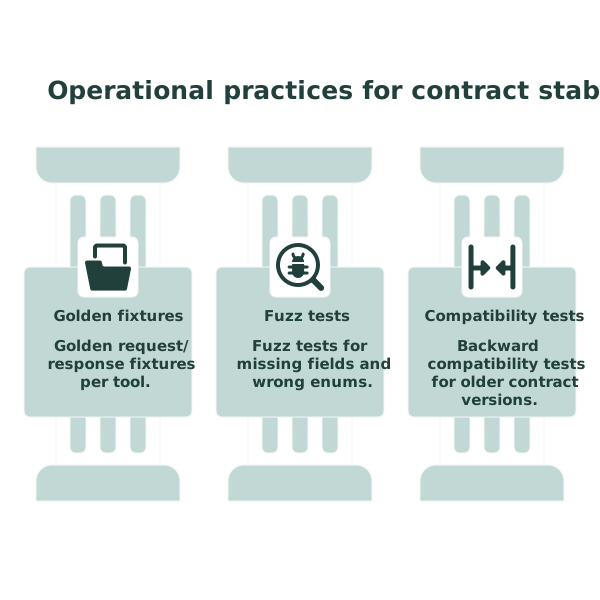
- Golden request/response fixtures per tool.
- Fuzz tests for missing fields and wrong enums.
- Backward compatibility tests for older contract versions.
Telemetry that highlights near-misses
Track validation failures by tool name, schema version, and field path. A spike often means an agent prompt drifted, a model update changed formatting, or a downstream system started returning new fields.
If you’re also fighting answer-quality risks like untrusted content shaping model outputs, pair contract enforcement with proactive audits. For example, a retrieval pipeline that can be manipulated may cause the agent to call tools with competitor or irrelevant entities; a focused approach like retrieval injection audits complements strict tool contracts by reducing the chance of corrupted intent before the tool call even happens.
Progressive trust for public or semi-public agent endpoints
If a tool endpoint is reachable outside your network boundary, treat it as an abuse target. Add layered protections: challenge suspicious traffic, progressively grant higher quotas, and separate “read tools” from “write tools.” This reduces the blast radius when an agent is tricked into making high-impact calls.
Implementation checklist for a safe tool layer
- Define strict input and output schemas for each tool.
- Reject unknown fields and ambiguous unions.
- Encode units and ranges; avoid floats for money.
- Return structured, field-level validation errors.
- Validate at a gateway/edge before side effects.
- Require idempotency keys for writes.
- Version contracts and log the version with each call.
- Add CI contract tests plus runtime telemetry.
Schema-validated tool contracts don’t make agents perfect. They make failures loud, local, and correctable—so “successful” calls can’t quietly rot your data.