What the LLM Shadow SERP is
The “LLM Shadow SERP” is the results page you don’t see. It’s the set of sources a model consistently pulls from when answering queries in your category, even when your website has the best primary information.
In classic SEO, you can inspect rankings. In LLM-driven discovery (AI Overviews, chat assistants, agentic search), the model often answers without showing a list of links. But it still has preferences: repeat-cited domains, formats, and passages. Those preferences form a shadow ranking system. If you’re absent from it, you’ll watch your expertise get paraphrased from secondary sources.
Why models prefer secondary sources
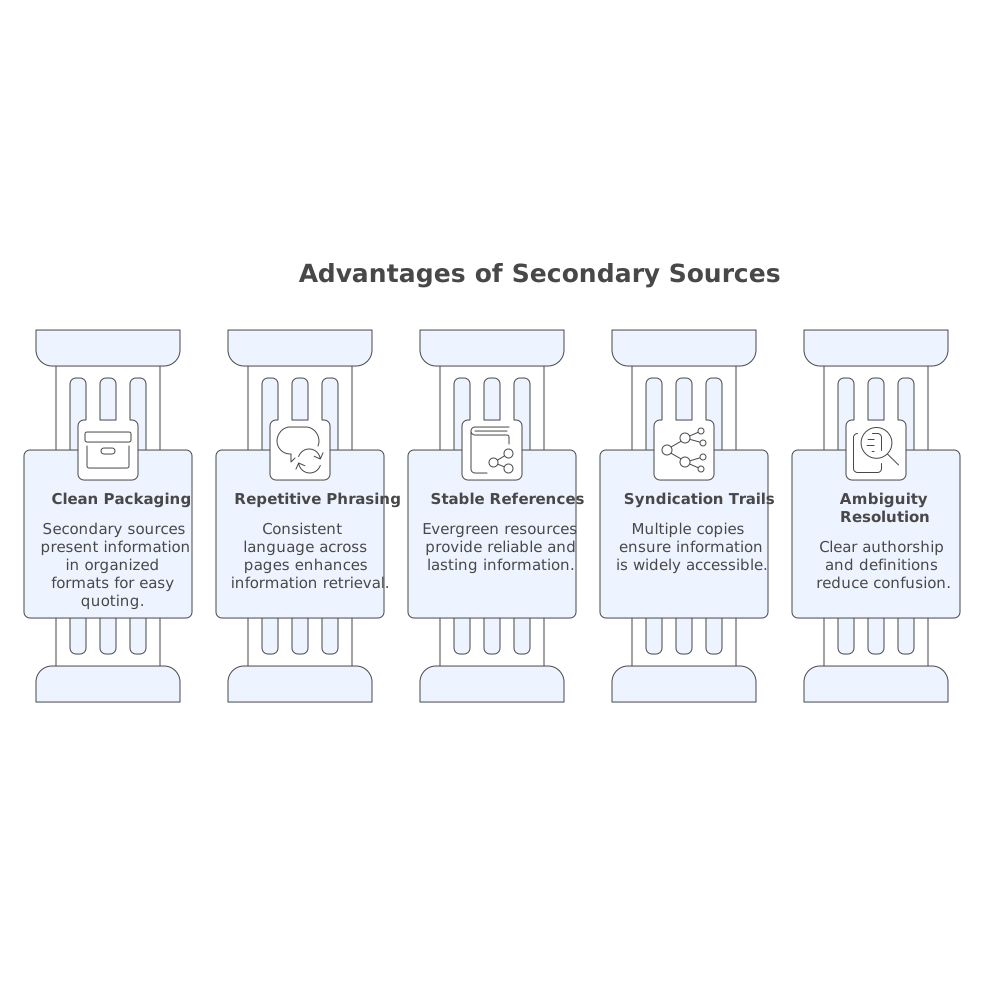
This usually isn’t about your content being wrong. It’s about the model being able to use it safely and repeatedly. Secondary sources often win because they:
- Package claims cleanly (definitions, bullet lists, “what to do” steps) that are easy to quote.
- Repeat the same entity and phrasing across pages, reinforcing retrieval.
- Provide stable references (glossaries, Wikipedia-style pages, documentation hubs) that look evergreen.
- Have strong syndication trails (citations, reprints, newsletters, listicles) that create multiple retrievable copies.
- Resolve ambiguity better than you do (clear authorship, dates, definitions, and scoped claims).
The consequence: the model “learns” your topic through intermediaries. Your website becomes the origin, but not the evidence.
How to detect your shadow SERP
1) Pick queries that trigger citation behavior
Start with 10–20 prompts where an assistant is likely to cite sources or paraphrase authoritative explanations:
- “What is [your concept]?”
- “Best practices for [your workflow]”
- “Common mistakes in [your niche]”
- “Compare [approach A] vs [approach B]”
- “Checklist for implementing [your product category]”
Keep the prompts stable. If you change wording every time, you can’t tell whether the model changed or your test did.
2) Run controlled tests across multiple surfaces
Don’t test in a single chat window and call it done. The shadow SERP differs by surface (AI Overviews vs chat assistants vs tool-augmented search). Run the same prompt set across at least two environments and record:
- Whether your brand/domain is mentioned
- Whether any sources are cited
- Which domains recur
- Which phrasing keeps appearing (definitions, steps, warnings)
You’re looking for repetition. If the same 5–15 domains keep showing up, that’s your shadow SERP.
3) Classify the sources the model prefers
Put recurring domains into buckets:
- Primary sources (original research, standards, first-party docs)
- Secondary explainers (blogs summarizing others)
- Aggregators (directories, “top tools,” comparison pages)
- Community sources (forums, Q&A sites)
If secondary explainers dominate, your job is to rebuild the evidence trail so the model can reach you first.
4) Compare the model’s “answer shape” to your page shape
Often the issue is structural. Models prefer passages that look like:
- Short definition + constraints
- Ordered steps
- Explicit “when to use / when not to use” guidance
- Clear terminology and entity naming
If your best page is narrative, mixed-topic, or buried behind UI, a secondary source that restates your idea in clean blocks will be easier to retrieve and reuse.
Fix the evidence trail so your site becomes the reference
1) Write a “reference layer” on top of your existing content
Don’t rewrite everything. Add a layer that is obviously citable:
- A tight definition paragraph near the top
- A section called “Key terms” with consistent phrasing
- A checklist or numbered workflow that matches how people ask questions
- A “common misconceptions” section that removes ambiguity
This is not about stuffing keywords. It’s about making your page the easiest place for a model to pull a correct, bounded answer.
2) Make entities unambiguous
Ambiguity is a silent killer in AI discovery. Ensure that your pages clearly communicate:
- Who wrote it (real author identity)
- When it was updated
- What the page is about (one primary entity/topic per page when possible)
- How it relates to other pages (internal links and consistent naming)
If you’re dealing with crawl inefficiencies or unclear canonicals, structured markup and explicit entity clarity matter. The approach in Fix AI crawl budget issues with structured data canonicals and clear entities maps well to these failure modes.
3) Close the “source diversity debt” gap
If a model only sees your ideas through one channel, it may treat them as less reliable than widely repeated concepts. You don’t need spammy syndication. You need legitimate diversity in how the idea appears across the web: summaries, citations, interviews, and references that point back to you as the origin.
This is where many teams accumulate “source diversity debt” without realizing it. If you want a practical framing of the patterns that tend to show up in AI Overviews, see Source diversity debt and the syndication patterns that improve AI Overviews coverage.
4) Align your page with the model’s retrieval needs
Models frequently pull the smallest sufficient chunk. Help them pick the right chunk from your site:
- Use descriptive subheads that match question intent (“How to…”, “Examples”, “Pitfalls”).
- Keep “one claim per paragraph” where possible.
- Put critical constraints next to the claim (avoid disclaimers buried at the end).
- Add examples that include inputs and outputs (what changes, what to expect).
If your content is great but fragmented, an AI will reconstruct it from someone else’s clean summary. Give it the clean summary first.
5) Monitor how models interpret you, not just whether they crawl you
Classic SEO monitoring focuses on indexing and ranking. For the shadow SERP, you also need to monitor interpretation: what the model thinks your page says, which passages it quotes, and which entities it associates you with.
This is the gap lunem is designed to address: continuous monitoring of how content is surfaced across LLM environments, with structured insights into what’s being used as evidence and what gets ignored. The goal isn’t to “game” outputs. It’s to make your site more discoverable, understandable, and actionable in AI-driven interfaces.
A practical workflow to operationalize the fix
- Baseline: Run your fixed prompt set and record recurring domains and phrasing.
- Gap map: For each query, note whether your site is missing a definition, steps, constraints, or examples.
- Reference layer: Add citable blocks to the page that should own the topic.
- Entity cleanup: Confirm canonicals, authorship, update dates, and consistent naming.
- Re-test: Repeat the same prompt set monthly and track whether your domain becomes a repeated reference.
If you do this well, you’ll see a specific change: secondary sources stop being the default “explainers,” and your page becomes the chunk the model prefers to reuse.
Vertical Video