Why Snowflake task sprawl happens
Snowflake Tasks are easy to create, schedule, and chain. That convenience becomes a liability when tasks multiply across schemas, owners, and environments. You end up with hidden dependencies, unclear “who changed what,” and brittle recovery when an upstream table changes or a downstream load silently succeeds with bad data.
Task sprawl is rarely about too many tasks. It’s about missing control points: code review, end-to-end lineage, deterministic ownership of a run, and a rollback plan that works at 2 a.m.
A pipeline pattern that stays auditable
The pattern below replaces ad-hoc task graphs with a code-first “control plane” that still uses Snowflake for execution. You keep SQL close to Snowflake, but move orchestration decisions into versioned code: parameters, dependencies, run leases, and rollback rules.
The goal is simple: every run is attributable, reviewable, and reproducible.
1) Define pipelines as code, not as scattered task objects
Instead of letting each team create tasks in-place, define pipeline specs in a repo. A spec is a small, explicit contract:
- Inputs: source tables, streams, files, or APIs
- Outputs: target tables, materialized views, or exports
- Run mode: batch, incremental, backfill
- Guards: required upstream freshness, data quality checks
- Rollback policy: what gets reverted and how
This is where a code-first platform helps. With windmill.dev, teams can keep workflows as DAGs with real code steps (SQL plus Python/TypeScript/Go when needed), while preserving diffs, branches, and code review habits that Snowflake Tasks alone don’t enforce.
2) Make end-to-end lineage a first-class artifact
Most “lineage” efforts stop at task dependencies or object references. End-to-end lineage for operations needs two layers:
- Static lineage: what a job intends to read/write based on the spec and SQL parsing.
- Runtime lineage: what a job actually touched during a specific run (tables, partitions, files, row counts, query IDs).
In Snowflake, runtime lineage is practical if you treat QUERY_ID as a join key for observability. Capture query IDs for each step, then materialize a small lineage table like:
- run_id, pipeline_id, step_id
- snowflake_query_id, warehouse, role, database, schema
- read_objects[], write_objects[]
- row_count_in, row_count_out, checksum samples
That table becomes your audit spine. It also makes “what changed” searches real, similar in spirit to the way strong internal playbooks preserve usefulness while reducing risk, like this approach to redacting PII and PHI without losing searchability.
Run leases prevent double-runs and partial ownership
Snowflake Tasks can overlap when schedules collide, retries stack up, or manual runs happen mid-cycle. Overlap is one of the most common sources of “phantom correctness”: both runs finish, but the resulting table reflects a race you can’t easily reproduce.
Lease model
A run lease is a lightweight lock with a TTL. Before a pipeline run starts, it must acquire the lease; if it can’t, it either exits or queues depending on policy.
- Lease key: pipeline_id + environment (+ optional partition key)
- Owner: run_id, commit SHA, actor
- TTL: renewed during execution; expires if workers die
- Fencing token: monotonically increasing number used to reject stale writers
Implementation options range from a dedicated Snowflake table with optimistic updates, to Redis/Postgres if you already have an operations database. The important part is fencing: any write step must validate it still owns the current token before committing.
What changes in practice
- Manual “rerun last job” becomes safe because it cannot silently overlap an active run.
- Retries become deterministic: only the lease owner can complete the run.
- Incidents become easier: you can say “run 2026-07-27T02:14Z owned token 881” and prove which queries were part of it.
Automated rollbacks that work with Snowflake
Rollback in data systems is usually hand-wavy because you can’t “undo” a transformation unless you plan for it. The pattern is to make rollbacks boring by constraining how writes happen.
Rollback primitives
- Staging-then-swap: write to a new table, validate, then swap/rename into place.
- Time Travel restore: restore a table to a prior timestamp when the retention window allows.
- Partition-scoped rewrites: overwrite only affected partitions (e.g., date-based) with fencing checks.
Pick one per dataset based on size and SLA. Staging-and-swap is the most universally reliable because it avoids partial writes. Time Travel is excellent for emergencies but shouldn’t be the only plan because retention, cost, and operational habits vary.
Rollback triggers
Automated rollback should be tied to clear signals:
- Schema mismatch detected after compile
- Quality checks fail (null spikes, uniqueness breaks, threshold drift)
- Downstream contract tests fail (expected columns, expected row ranges)
- Fencing token violation (stale run attempted to write)
When a trigger fires, the pipeline should mark the run as failed, emit an alert, and execute the dataset’s rollback primitive with the last known-good reference (prior table, prior timestamp, prior partition snapshot).
Code review and change control without slowing teams down
The main reason teams rely on direct Snowflake Tasks is speed. You can keep that speed while still requiring review by separating “authoring” from “publishing.”
A simple workflow
- Develop and test pipeline changes in a branch (including backfill simulations).
- Require a diff-based review: spec changes, SQL changes, and rollback policy changes.
- On merge, a deploy job updates Snowflake objects (procedures, tasks if you still use them, grants) and registers the new pipeline version.
Platforms like Windmill support this model with Git sync and environments, while still letting you run the same code locally for faster iteration and safer debugging.
Operational visibility you can act on
Once lineage and leases exist, monitoring becomes more than “task succeeded.” The minimum useful dashboard is:
- Run timeline with step durations and Snowflake query links
- Lease ownership and queued/blocked runs
- Row counts and drift thresholds per output
- Rollback events with reason codes
Alerting should be opinionated: only page when a dataset is late and downstream impact is likely. A lightweight intake contract for incidents and work requests helps keep pipeline changes from becoming a flood of pings; this structure is similar to an issue intake contract for a single prioritized backlog.
How to migrate without a big-bang rewrite
- Start by inventorying existing tasks and grouping them into “pipeline units” by output table.
- Wrap first: keep tasks, but add a wrapper that acquires a lease and records runtime lineage.
- Standardize writes on staging-and-swap for the highest-risk datasets.
- Move orchestration into code-defined DAGs gradually, one pipeline at a time.
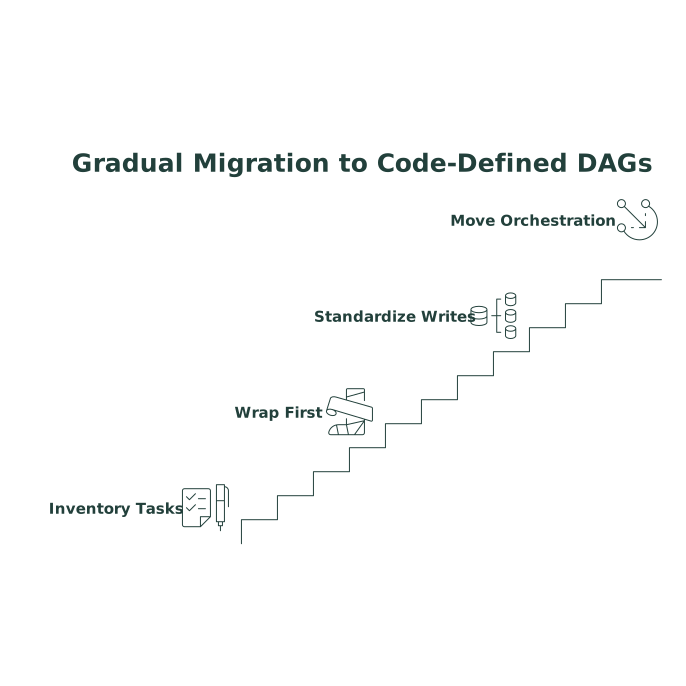
This path reduces risk because each step increases auditability without requiring you to stop delivery.